



Hey friends,
The guided portion of Conscious Creation is wrapping up this week, but I hope you’ll continue to track on your own. To help you along your continued journey, I built an interactive prompt library that contains every prompt from the entire program, including new prompts from this week, that you can revisit any time you want to run or rerun your data moving forward. For future reference, you can find the prompt library (and all other subscriber tools) by visiting tools.badgirlmedia.com. I also added it as a link on the homepage. (Passwords are at the bottom of this post.)
When I designed Conscious Creation back in the fall, I mapped out twelve weeks of guided content: essays, frameworks, AI prompts, weekly reflections, etc. I chose twelve weeks because that’s how long I believed it takes for tracking data to become genuinely useful, for the patterns to get undeniable, and for the habit of paying attention to your own life to actually stick.
And I still believe that twelve weeks of data is better than eight. The patterns get sharper and the self-knowledge gets deeper with every additional week of data behind you.
But by the time I finished writing Week 7 (and had real user feedback to reference against my initial syllabus) I realized the remaining four weeks of planned content were repackaging ideas you already have. The frameworks were built, the AI prompts were delivered, the crucial concepts like systems thinking, keystone habits, feedback loops, and failure points have already been shared. What was left in my outline was essentially the same material we’ve already covered: “energy and the cascade effect” (which is just systems thinking applied to your body), “input curation” (systems thinking applied to consumption), “identity vs behavior” (which the entire program has been teaching implicitly since Week 1).
I could have written those weeks and they would have been just fine, but this program is built on a very specific premise—that you follow the evidence instead of the plan when the evidence tells you the plan is wrong—and it would be pretty hypocritical to ignore that premise just because my original plan said twelve weeks.
There is still lots of work to be done, but the rest is application, and you now have everything you need to continue on your own. The remaining weeks are about you using the tools you already have as your dataset continues to grow.
As such, this week’s post is built differently from the others. It’s less essay and more reference material. I want this to be the thing you can come back to in a month, or a quarter, or six months, when you want to re-run your analysis or you’ve noticed yourself drifting and need to figure out where your system is breaking down.
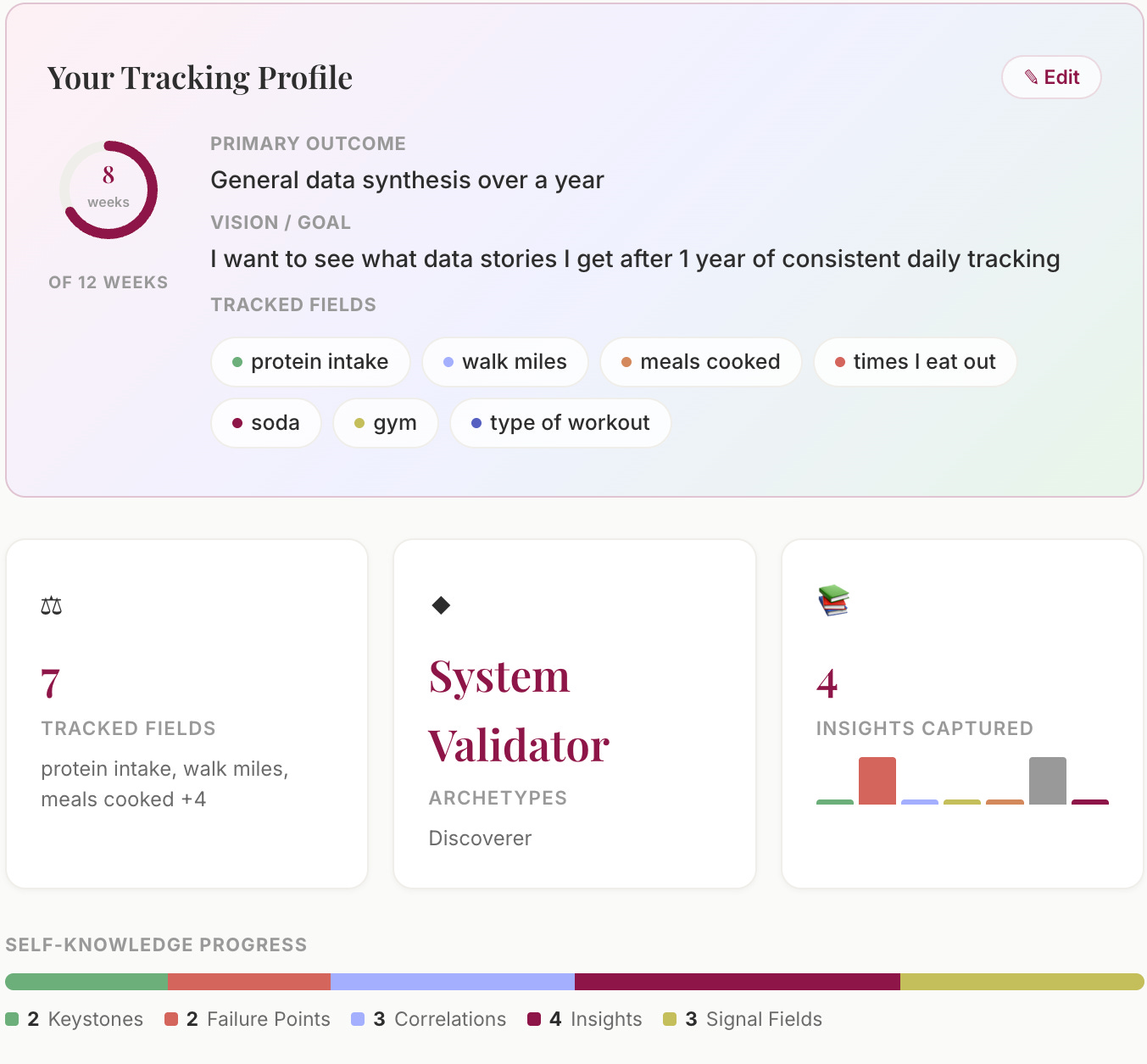
Quick note before we get into the final post: So far, I’ve built the prompt library, but I’m currently working on an interactive toolkit that will cover the entire Conscious Creation program. This will be as useful for newbies as it will for people continuing along on their current journey. It will include the full prompt library with additional prompts, help with creating and/or editing your tracker, finding your tracker archetype, understanding and creating graphs and other visuals from your dataset, weekly/monthly/quarterly review assessments, and more. You’ll also be able to build a personal dashboard that will track your insights along the way. I hope to have it done in the next couple of weeks, and I’ll update you when it’s ready.
Here’s a sneak peek of the dashboard:

One last check-in.
Before we shift from guided to self-directed, I want to offer you a few things to reflect on.
How has your relationship with the tracker changed since Week 1? Most people start out treating it like a chore and end up treating it like a mirror. If you’re still filling it in every day, something has shifted in how you relate to your own data, even if you can’t articulate what that shift is yet.
Is the system you built in Week 6 still running? If it is, that’s a meaningful accomplishment. Most behavioral changes don’t survive two weeks, so give yourself some credit for that. If it broke, look at why, and look at whether the Week 7 systems analysis told you it was aimed at the wrong target. You can adjust this as many times as you need to.
And the big one: do you trust the data more than your memory now? Because if the answer is yes, the program did what it was supposed to do. Everything else is just technique.
So, what changes now?
The guided essays stop after this one, but the tracking doesn’t have to. I've been tracking for 90 days, and plan on continuing mine as well. I’ll be running experiments and integrating my data into my life in other ways. Plus, I am a huge data nerd so I can’t wait until the end of the year when I can look at an overview of everything. (How stupidly exciting!)
You now have a set prompts, frameworks, and an understanding of how your specific system runs, and these will work on any amount of data. The more data you feed them, the better they work. Eight weeks is enough to see the patterns, but twelve weeks makes them undeniable. At six months they’ll become predictive, and a year makes them transformative.
But the thing about any structured program is that the default outcome is that you will gradually start to drift. This drift is predictable though, which means you can plan for it. You don’t need to track everything forever and you don’t need me writing essays to keep you honest. But you do need a minimum viable system that catches the drift before it compounds, and you need to set it up now, while the habits are still warm, not three months from now when you’ve already slid back to your defaults.
What I’m giving you below is everything you need to keep going on your own: an inventory of what you learned, a reassessment of where you are now, archetype-specific guidance for what to focus on next, the complete prompt library from the entire program, and a sustainable rhythm for checking in with your data going forward. (Plus the interactive dashboard builder that’s coming soon!)
This is your toolkit. I hope you’ll continue to use it :)
First, write it down before you forget it.
Before anything else, I want you to document what this program actually taught you. Not in vague terms like “I learned a lot about myself,” but in specific findings, written down, so you can reference them in a month when the details start to blur.
Fill this out now, while it’s fresh. This becomes the reference document you check against during your monthly and quarterly reviews.
(These will all be available to fill out on the interactive dashboard, as well. If you answer these now, you can simply transfer them over when the tool goes live.)
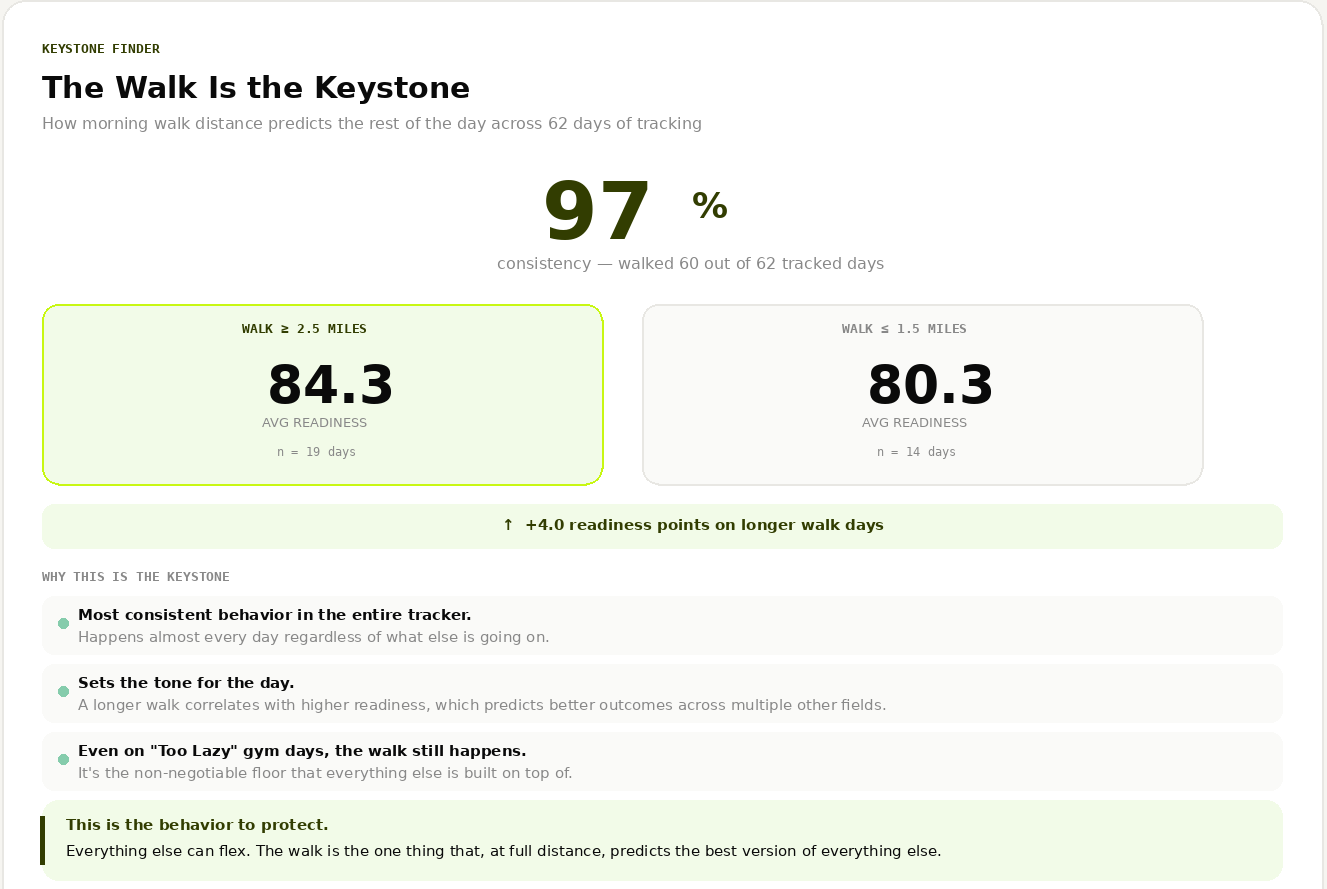
KEYSTONE DISCOVERIES:
What one or two habits, when maintained, create positive effects across multiple areas of your life?
[Specific keystone habit from your tracking data] Evidence: [How you know this matters — what correlations you observed]
[Specific keystone habit from your tracking data] Evidence: [How you know this matters — what correlations you observed]
Keystone example from my personal data:
FAILURE POINT DISCOVERIES:
What breakdowns create the widest negative cascades?
[Specific failure point from your tracking data] Evidence: [What happens across other domains when this fails]
[Specific failure point from your tracking data] Evidence: [What happens across other domains when this fails]
CORRELATION DISCOVERIES:
What reliably predicts what in your system?
When [X happens], [Y] consistently follows
When [X happens], [Y] consistently follows
When [X happens], [Y] consistently follows
PATTERN DISCOVERIES:
What patterns about yourself did tracking reveal that you genuinely didn’t know before?
[Specific pattern about your energy, behavior, output, etc.]
[Specific pattern about your energy, behavior, output, etc.]
[Specific pattern about your energy, behavior, output, etc.]
CONFRONTATION DISCOVERIES:
Where did your data contradict the story you were telling yourself?
I thought I was [identity claim] but my behavior showed I’m actually [behavioral reality]
To close this gap, I need to consistently demonstrate [specific behaviors]
These are your core insights. Everything else was useful for pattern recognition but doesn’t need to be remembered in detail. This list is what you’re protecting going forward.

Reassess your archetype.
In Week 5, I introduced five archetypes based on what your data looked like at that point: Pattern Finder, System Validator, Discoverer, External Reactor, and Confronter. You used that archetype to guide what kind of system you built in Week 6.
Eight weeks in, it’s worth reassessing, because your archetype may have shifted.
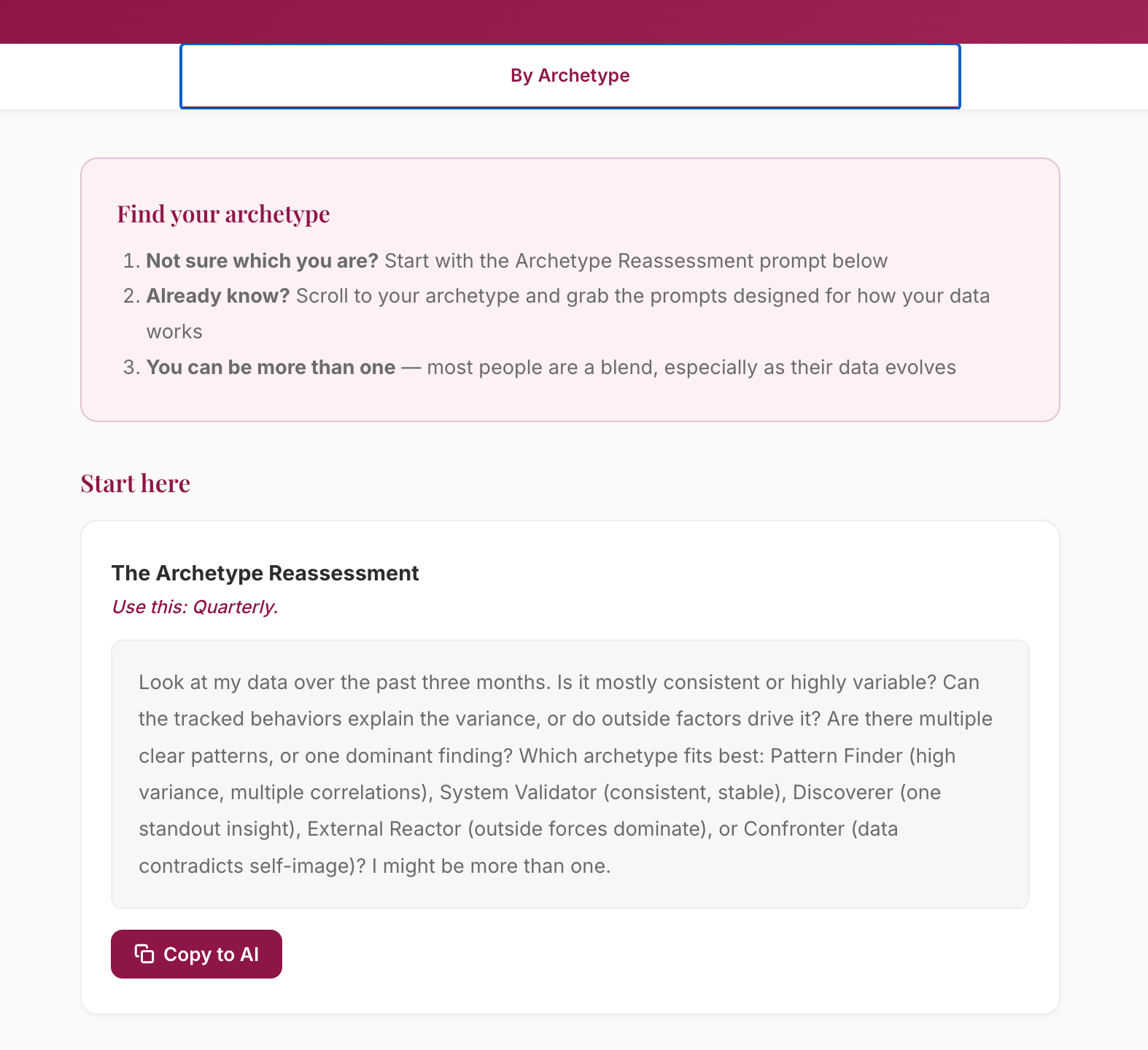
Note: If you’re in the prompt library, you can sort “by archetype” and the reassessment is located at the top, and all archetype-specific prompts are under it:
If you were an External Reactor in Week 5 because outside forces were dominating your data, but you’ve since built a minimum viable routine that holds even on chaotic days, you might now be a Pattern Finder with enough stability to start seeing real correlations.
If you were a Discoverer who found one key insight and built around it, and that system has been running for two weeks, you might now be a System Validator, someone whose data is consistent enough that the next move is experimentation rather than pattern-hunting.
If your Week 7 systems analysis revealed a gap between what you believed and what your data actually showed, you might have picked up Confronter as an additional layer, regardless of what your primary archetype was.
Here’s the thing I want to make explicit: you can be more than one, and you will shift over time. A System Validator for your physical health and a Pattern Finder for your creative output. A Discoverer in one domain and a Confronter in another. Your data is multidimensional and your archetype will be too.
Every time you come back to this material (monthly, quarterly, whenever) re-run the archetype assessment. Ask yourself: is my data consistent or variable right now? Can my tracked behaviors explain the variance? Am I seeing multiple patterns or one key insight? Does my data match my self-image? The answers will change as your system evolves, and the guidance you follow should change with them.
Where to focus next, by archetype.
If you’re currently a Pattern Finder:
You see how things connect. Your Week 7 analysis probably revealed multiple feedback loops and correlations. The risk for you now is analysis paralysis, seeing so many connections that you don’t know which one to act on.
Your focus for the next month: pick the ONE upstream lever with the highest downstream impact and protect it obsessively. Don’t try to optimize five things. Optimize the one thing that your data says moves the most other things, and let the downstream effects take care of themselves. Re-run the Keystone Finder prompt monthly to check whether your highest-leverage behavior has changed.
Your ongoing prompts: Keystone Finder, Loop Mapper, Upstream/Downstream Audit.
If you’re currently a System Validator:
Your systems work and your data is consistent. Your risk is complacency, staying comfortable in a stable routine without testing whether a better version exists.
Your focus for the next month: design one controlled experiment. Change one variable for two weeks and track what happens. You have the stable baseline that makes experimentation meaningful, which is an advantage most people don’t have. Use it. If the experiment improves things, integrate the change. If it doesn’t, you’ve lost nothing because your baseline is solid.
Your ongoing prompts: Before/After System Check (run it after each experiment), Full System Map (quarterly, to see if your stable system has any hidden weaknesses).
If you’re currently a Discoverer:
You found the thing and you built around it. Now your job is to decide whether that one finding is still the most important lever, or whether the system you built around it has revealed a new insight that matters more.
Your focus for the next month: re-run the full analysis suite from Week 7 with your updated data. Your system change may have shifted the dynamics enough that a different behavior is now the keystone, or a different failure point has emerged. Discoverers who don’t reassess tend to keep optimizing around their original finding long after the system has evolved past it.
Your ongoing prompts: Keystone Finder (monthly), Failure Point Detector (monthly), the full suite (quarterly).
If you’re currently an External Reactor:
Outside forces still drive a lot of your data, and that’s fine. The question isn’t whether external disruption exists because it always will. The question is whether your minimum viable routine is holding even on your hardest days.
Your focus for the next month: refine your floor. What’s the absolute minimum set of behaviors you maintain even when everything else falls apart? Track your adherence to that floor specifically. If you’re hitting it 80% of the time, start raising it slightly. If you’re below 60%, the floor is too high and you need to lower it until it’s actually sustainable under real-world stress.
Your ongoing prompts: Failure Point Detector (to identify what breaks first under pressure), Before/After System Check (to measure whether your floor-holding days produce meaningfully better outcomes than your floor-breaking days).
If Confronter applies to you right now:
Your data showed a gap between your self-image and your behavior. The constraint you built was designed to close that gap. The question now is whether it’s working.
Your focus for the next month: measure the gap again. Run the same comparison you ran in Week 5 or 7 and see if the numbers have moved. If the gap is closing, keep the constraint and give it more time. If the gap is the same or wider, the constraint isn’t addressing the real issue and you need to redesign it, probably by looking upstream of the behavior you targeted.
Your ongoing prompts: the Confronter-specific prompt from Week 6 (re-run monthly), Upstream/Downstream Audit (to check whether you’re targeting the right level).