


This is a long one so I’ve added a Table of Contents for easier browsing.
Why we’re unreliable narrators of our own lives (why data matters)
How to conduct your own audit
What dictates drift vs. success?
What did your money say you valued? (Finance audit)
How did your mood correlate to your output? (Emotional audit)
What did you ship? (Outputs audit)
Finding your Soul Data
Building your own 2026 infrastructure

If you’ve been with me for a while now, you probably know that I absolutely love data. Not in the “I like reading statistics” way, but in the “I see the world as inputs, outputs, and feedback loops” way. There’s something deeply satisfying about turning the chaos of daily life into something observable. A chart or graph about your own real life data isn’t just pretty, it can be revelatory. This is systems thinking at its core: stripping away noise to see the mechanics underneath.
Over the last few years, I’ve figured out how to turn this lens inward. Data collection isn’t exciting in the moment (it’s tedious, actually, if I’m being honest) but now it’s something I’m genuinely passionate about because the payoff is massive. Treating your life as a project worth tracking is the only way to gain real clarity.
And I rely on this data so heavily because I’ve learned a hard truth:
We are all unreliable narrators of our own lives.
If I asked you right now to evaluate how your 2025 went, you’d probably provide a summary based almost entirely on the last few weeks. Maybe the last couple months if you’re being generous. Human memory doesn’t function like an accountant’s ledger; it functions like a screenwriter. It edits out the boring days, highlights emotional peaks, softens the sharp edges of failure, and bends timelines to fit whatever narrative makes you feel safe. And that safety can feel comfortable, but it comes at the cost of truth.
To actually understand the year you just lived, and to set yourself up for a successful 2026 (and beyond), you have to stop relying on memory and start looking at evidence.

Data is beautiful… and it’s your surest path to real change.
On January 1, 2025, I decided to quit smoking weed after nearly a decade of daily use. As I write this, I’m approaching one year sober. But I didn’t get there on willpower alone… I tried at first, but after only a few weeks, I felt totally defeated. I felt like I was so tired and worn down from withdrawal symptoms that it would be easier to simply begin smoking again because at least then I would be able to focus and be productive. Luckily, I’d made my mind up in 2024 that I was definitely going to quit, so I sucked it up and ended up building myself a journaling framework (now called THE DAILY 5) to keep myself going… and honest. Writing things down every single day forced me to confront my habits rather than ignore them. It gave me willpower in a sense.
But here’s the more important thing that the data actually revealed that I would never have seen otherwise: I was making progress even when it felt like I wasn’t. The first month was absolutely brutal. Sleep was a disaster, my skin was breaking out, my anxiety was through the roof, I felt irritable and angry, and it seemed like I was stuck in a vicious loop I’d never break out of. Every day felt identical in its awfulness. My subjective experience told me nothing was improving. I felt stuck in an endless slog of discomfort and negativity.
The data told a different story, though. When I went back through my journal entries after week three, I could see measurable changes I hadn’t noticed while living through them. My sleep wasn’t “good,” but I was getting 6 hours instead of 4. My windows of anxiety were lasting 30 minutes instead of two hours. The physical symptoms were cycling through predictable patterns rather than random chaos.
Without documentation, I would have trusted my feeling of “this isn’t working” and probably would have just started smoking again to make everything go back to “normal.” But because I’d been documenting everything, I could see the actual trajectory: slow, grinding improvement that my subjective experience couldn’t register because each day still felt bad. I learned firsthand that the difference between “bad” and “slightly less bad” isn’t something you can feel in real time. But you sure can measure it!
This is the core value of the yearly audit: It interrupts the feedback loop before you can rationalize your way around it. Your brain will lie to you about progress, but your bank account won’t. Your calendar won’t. Your Screen Time won’t. Your journal entries won’t.
By the end of this post, you’ll know how to conduct your own audit using data you already have—even if you didn’t track anything consciously this year. I’m going to walk you through the five core diagnostic questions that reveal the difference between drift and construction, show you where your digital trail lives, and give you a framework for 2026 that makes next December’s audit effortless. But first, let me show you what’s possible when you actually look at the data.
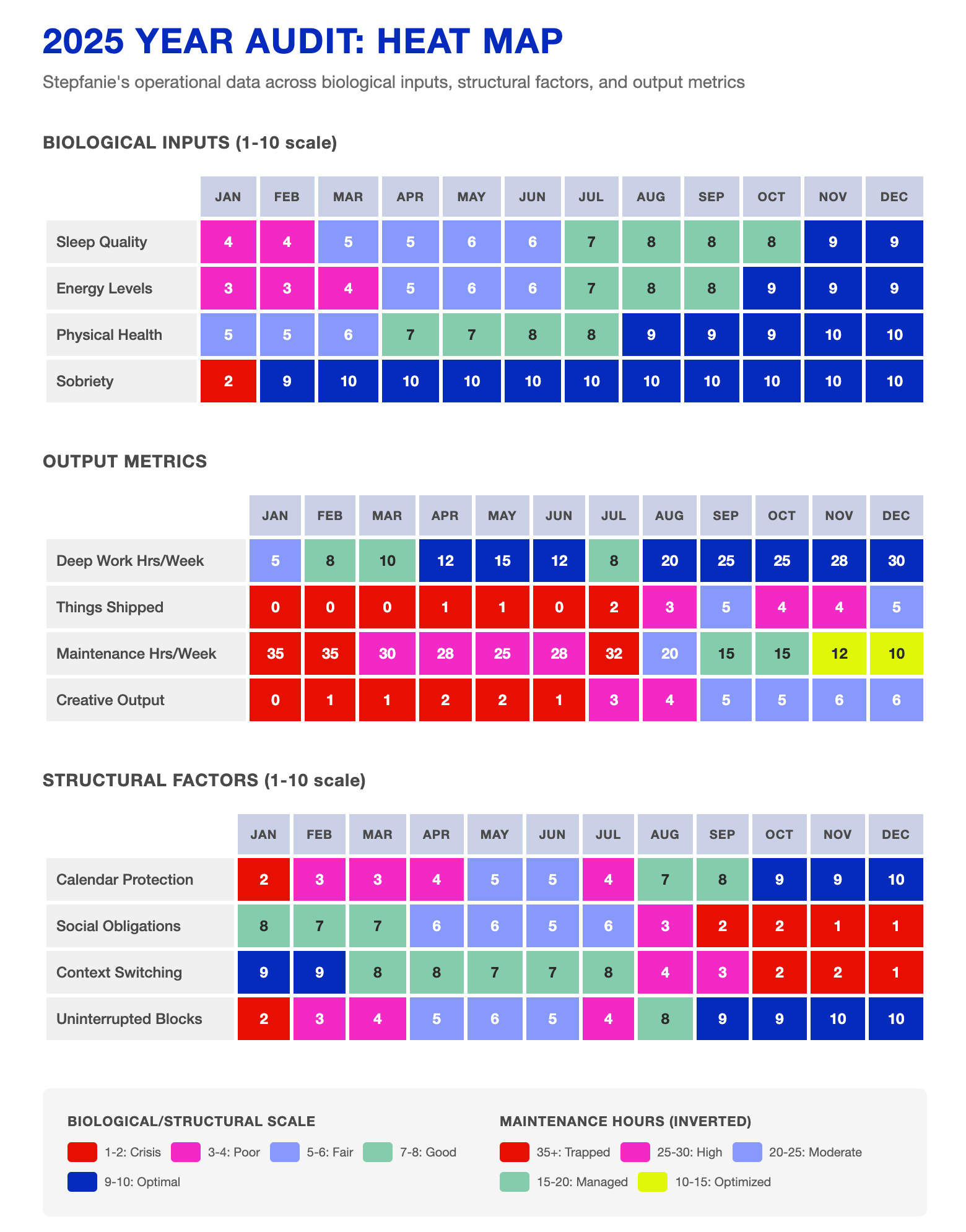
I’m also currently building a master dashboard in Notion that consolidates everything—calendar data, Oura metrics, finances, movement, monthly reflections, quarterly audits, and soul data logs—all in one place. It’s designed to be customizable so you can track what actually matters to your life, not just what some productivity guru says you should measure. I’m finalizing the template now to make sure it works for different types of work and life structures, and I’ll be sharing it with paid subscribers in the coming weeks. (Stay tuned!)

How to conduct your own audit:
The heat map you see above isn’t magic, it’s just systematic observation applied to life data you already have. Most people never look at this information because they assume they know what happened. But memory is editorial… data is the raw footage.
A real systems audit isn’t a list of wins and losses or some fluffy “gratitude journal” bullshit. It’s an investigation into how your machine actually functioned this year. You’re looking for the mechanical relationships between inputs and outputs, identifying the specific variables that caused drift versus the ones that enabled construction, and finding the patterns your subjective experience missed because you were too close to see them.
Even if you didn’t keep a perfect journal this year (most people didn’t), you still left a digital trail. Your calendar knows where your time went, your bank statements know what you prioritized, your camera roll knows what caught your attention, your Spotify knows what emotional states you returned to, your Screen Time data knows when your nervous system was dysregulated, etc.
This audit has five core sections, each designed to answer a specific diagnostic question about your year:
What actually dictated drift vs. success? — Identifying the structural variables that caused you to fall off track versus the ones that enabled your best work.
What did your money say you valued? — Examining the gap between stated priorities and actual spending to see where your resources really went.
How did your mood correlate to your output? — Tracing the biological inputs that predict productivity crashes 2-3 days before they happen.
What did you actually ship? — Distinguishing between activity (maintenance work) and progress (construction work) to see if you spent the year treading water or building something new.
The soul data — Examining what you returned to repeatedly when no one was watching, revealing the subconscious patterns that predict where you’re headed next.
Each section has specific data sources to examine and concrete questions to answer. By the end, you’ll have a complete diagnostic of your 2025 operating system, and you’ll know exactly which variables to update in 2026.
