


Quick note: this essay lays out the complete energy-first scheduling system I use to structure my week, but it comes with something I’ve been excited to announce! I built an interactive tool that lets you actually do it. You rate your energy, categorize your tasks, and generate your own personalized weekly schedule. It's the first in a library of tools I'm building for paid subscribers. More on that below.

Every couple of weeks, someone in my comments or my DMs says some version of “There’s no way you actually write all of this yourself” or “I don’t believe one person can publish this much” or my personal favorite “You must have a team.”
But I don’t have a team. I have a desk, an espresso machine, and about ten hours a day that I’ve deliberately chosen to spend building something instead of consuming something. That’s it, that’s the whole mystery.
I’m not saying this to brag about being a workaholic and I don’t think there’s something inherently virtuous about working as much as I do. I’m saying it because the disbelief always reveals something more interesting than the question itself. When someone tells me they “can’t believe” I produce as much as I do, what they’re really telling me is that they’ve never sat down and done the math on where their own hours actually go. Because… the math is not complicated. The average American spends several hours a day watching television and several more hours on their phone doing things that don’t meaningfully improve their lives. That’s a meaningful chunk of hours, every single day, that aren’t going anywhere in particular.
I rarely watch Netflix, I’m not on TikTok, I don’t doomscroll before bed. I’m not morally superior for any of this, I’ve simply made a decision about what I want to spend my finite hours on, and I’ve built boundaries around that decision so I don’t have to remake it every night when I’m tired and the couch looks inviting. The output isn’t a mystery, It’s a consequence of my allocation.
But the thing I wish I knew sooner was, choosing to spend the hours is only half the equation. The other half, the half that most productivity advice completely ignores, is when you spend them and on what. Because I can sit at my desk for ten hours and produce something genuinely good, or I can sit at my desk for ten hours and produce garbage, and the difference between those two outcomes has almost nothing to do with effort or discipline. It has to do with whether I matched the right work to the right window of energy.
I’m about as anti-woo-woo as it gets, but before you write me off, hear me out.
Realizing my energetic windows could align (or not) with my work is what led me to build a system I think of as energy-first scheduling, and it draws from a few people smarter than me. Daniel Pink wrote an entire book called When about the science of timing, and one of his core findings is that our cognitive abilities don’t stay constant throughout the day, instead, they follow predictable patterns based on chronotype, with most people hitting an analytical peak in the morning, a trough in the early afternoon, and a rebound in the late afternoon that’s actually better for creative and insight work. Cal Newport has written extensively about the concept of deep work and how protecting uninterrupted blocks of concentration is more valuable than any amount of shallow busyness.
Those two frameworks, paired with tracking my own energy patterns through what I call energy mapping in The Daily 5, gave me real data about when my specific brain is ready to create vs needs a break.
The synthesis of all of that looks something like this: instead of building your week around your obligations and hoping you’ll have energy left over for the things that matter, you build your week around your energy patterns and fit the obligations into the gaps. It sounds like a small inversion, but it’s changed everything about how I work.
The fundamental error most people make.
First off, I’m not the same person at 9am that I am at 3pm. Not in terms of willpower, not in terms of creativity, not in terms of patience, not in terms of my ability to make good decisions. And neither are you.
This shouldn’t be controversial. Pink’s research on timing shows that cognitive function follows a daily arc that’s as predictable as the tides. Decision fatigue is real and measurable, creative thinking tends to peak at different times than analytical thinking, most people’s self-control is highest in the morning and lowest in the evening. None of this is news to anyone who has read the research.
And yet we build our weeks as if we’re machines running at constant RPM from wake to collapse. We schedule the important presentation at 4pm because that’s when the conference room was available. We save the creative work for “later” because the morning got eaten by emails. We make major life decisions at 10pm because that’s when we finally have a quiet moment, even though our decision-making capacity has been degraded by fourteen hours of micro-choices and social performance.
Most of us are perpetually scheduling the wrong tasks for the wrong versions of Ourselves.
So, how do you break this cycle?
The principle is simple: map your energy patterns, categorize your work by what kind of energy it requires, and then match them. The hard part isn’t the concept, it’s the tracking, the honesty, and the willingness to protect the structure once you’ve built it.
Step 1: The energy audit (one week of paying attention)
Before you redesign anything, you need data. Not guesses, or vibes, or what you think your energy patterns are based on some article about chronotypes you read three years ago. Actual data from your actual life.
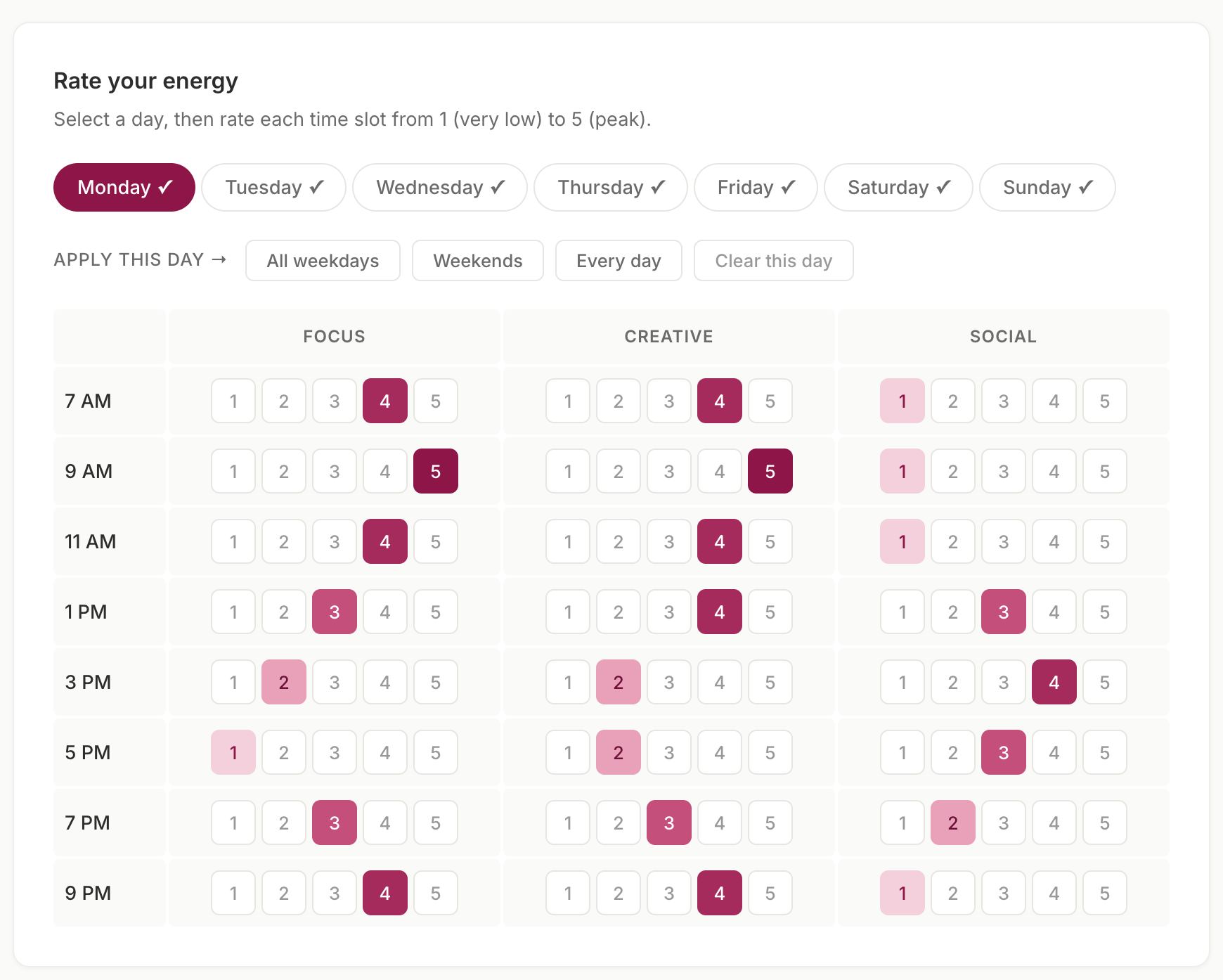
For one week, set a recurring alarm for every two hours during your waking day. When it goes off, rate three things on a scale of 1 to 5:
Focus: how easily can you concentrate right now? Could you read something dense, or would you struggle to follow a recipe?
Creative energy: do you feel like you could generate new ideas, write, brainstorm, problem-solve? Or does everything feel flat and derivative?
Social bandwidth: do you have the patience and warmth for other humans right now, or would even a simple phone call feel like an assault?
Write it down somewhere. A notes app, a scrap of paper, whatever. Don’t overthink the format. What matters is that you’re capturing a snapshot of your capacity at regular intervals throughout a normal week.
By Friday you’ll have a map, and I promise it will contain at least one surprise, because when I did this, I discovered that my creative peak wasn’t first thing in the morning like I’d always assumed. It was between 9am and 1pm, after I’d been awake for a few hours and had some coffee and movement. My mornings before 9 were actually better for administrative work and clearing inboxes, the stuff that requires attention but not invention. And my social bandwidth basically fell off a cliff after 5pm.
Pink calls this the peak-trough-rebound cycle, and while the specifics vary by chronotype (early birds peak earlier, night owls peak later), the pattern itself is remarkably consistent. The point isn’t to match my pattern though, it’s to discover yours.
Step 2: The task taxonomy
Once you have your energy map, categorize the work you actually do in a given week. Not by urgency or importance (the Eisenhower matrix has been beaten to death) but by what kind of energy each task demands.
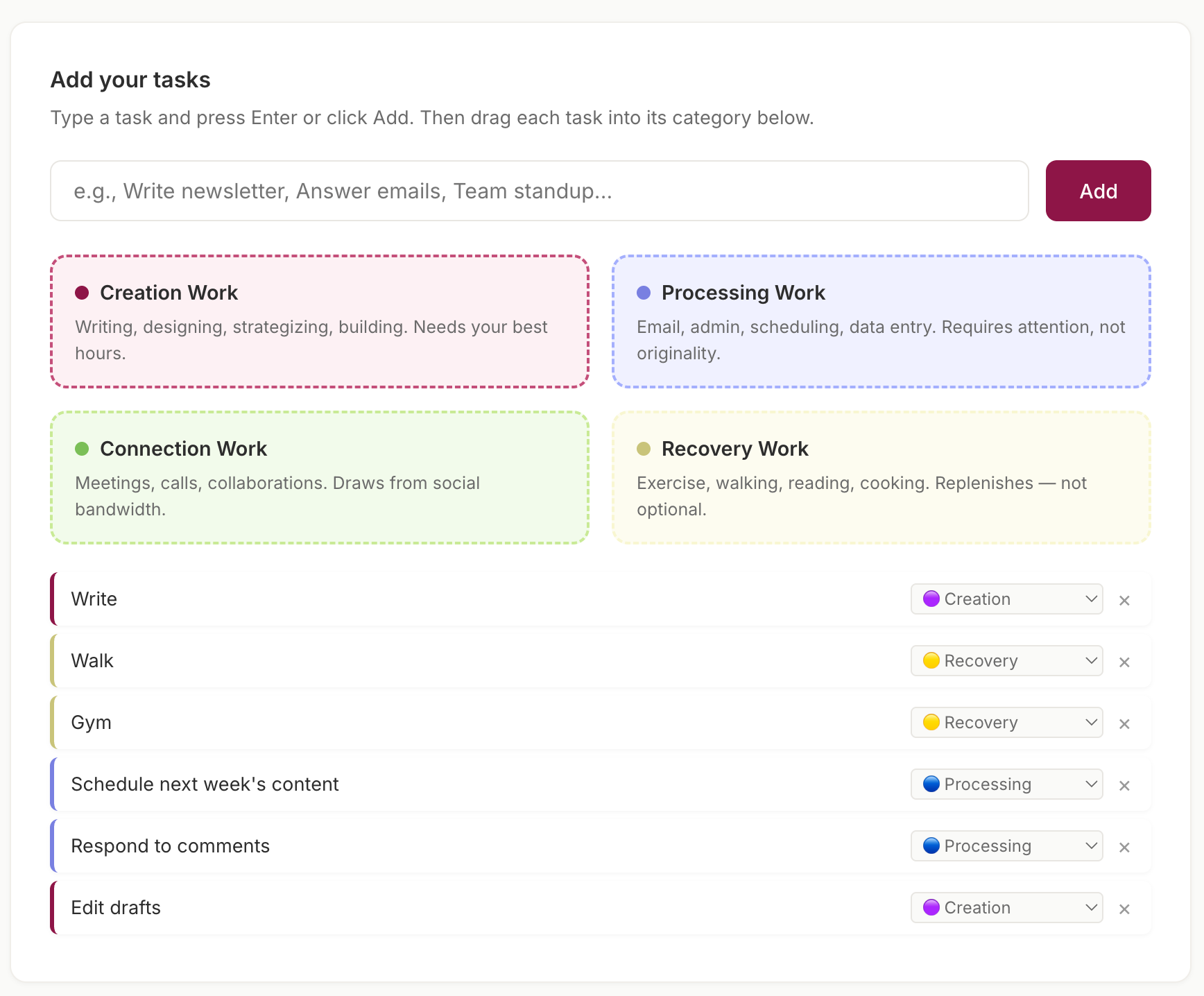
I use four categories:
Creation work: writing, designing, strategizing, building. Anything that requires you to generate something that didn’t exist before. This is the most energy-expensive type of work and it needs your best hours or it will be mediocre. This is what Newport calls “deep work,” and his central argument is right. The ability to perform this kind of concentrated cognitive effort is both increasingly rare and increasingly valuable. Protect it accordingly.
Processing work: email, admin, scheduling, data entry, returning calls, paying bills, ordering supplies. This requires attention but not originality. You can do this when your brain is at 60% and it’ll be fine.
Connection work: meetings, one-on-ones, phone calls, collaborations, difficult conversations. This draws from your social bandwidth, which is a separate reservoir from your cognitive bandwidth. Some people have more of this than others; neither is better, but you need to know your limit.
Recovery work: exercise, cooking, walking, reading, anything that replenishes rather than depletes. I’m calling it “work” deliberately, because if you don’t schedule it, it won’t happen, and then everything else suffers. This isn’t optional maintenance, it’s actually load-bearing infrastructure.
Go through your typical week and tag everything. You’ll probably notice that most people front-load their days with connection work (meetings all morning) and then try to do creation work in the wreckage of the afternoon, which is exactly backwards for most human brains.
Step 3: The match
Take your energy map from Step 1 and your task taxonomy from Step 2 and match them.
Your highest-focus, highest-creativity hours get creation work. Non-negotiable. This is the most important thing you do and it gets the best version of you.
Your moderate-focus hours get processing work. You don’t need to be brilliant to answer email, you just need to be functional and attentive.
Your highest social-bandwidth windows get connection work. Schedule meetings and calls here, and protect the rest of the day from them.
Your lowest-energy periods get recovery work. Stop pretending you’re going to do deep thinking at 3pm on a Tuesday. Go for a walk. Let your brain defragment.
When I restructured my week this way, two things happened almost immediately. My creative output got better because I was working at the right time. An hour of writing at 11am produced more usable material than three hours at 4pm ever had. And I stopped feeling guilty about the low-energy periods, because they had a job now. They aren’t wasted time, they’re recovery time, and recovery is on the schedule because it’s supposed to be there.
Before I get into the rest of the system, I actually built a tool for this.
I’ve been thinking for a while about how to make these frameworks more than just essays you read and nod along to. Reading about energy mapping is useful, but actually doing it is different. So I built an interactive tool that walks you through this entire process step by step. You rate your energy by the hour, categorize your tasks, and it generates a personalized weekly schedule based on your actual patterns.
This is the first tool in what’s becoming an interactive library for paid subscribers. The essays give you the thinking, and the tools help you use it. I’ll be building more of these based on the same principle every time: take the framework, make it functional, put it in your hands.
Here’s what the energy-first-week-builder looks like:
First, you’ll rate your energy for each day in 2-hour blocks.
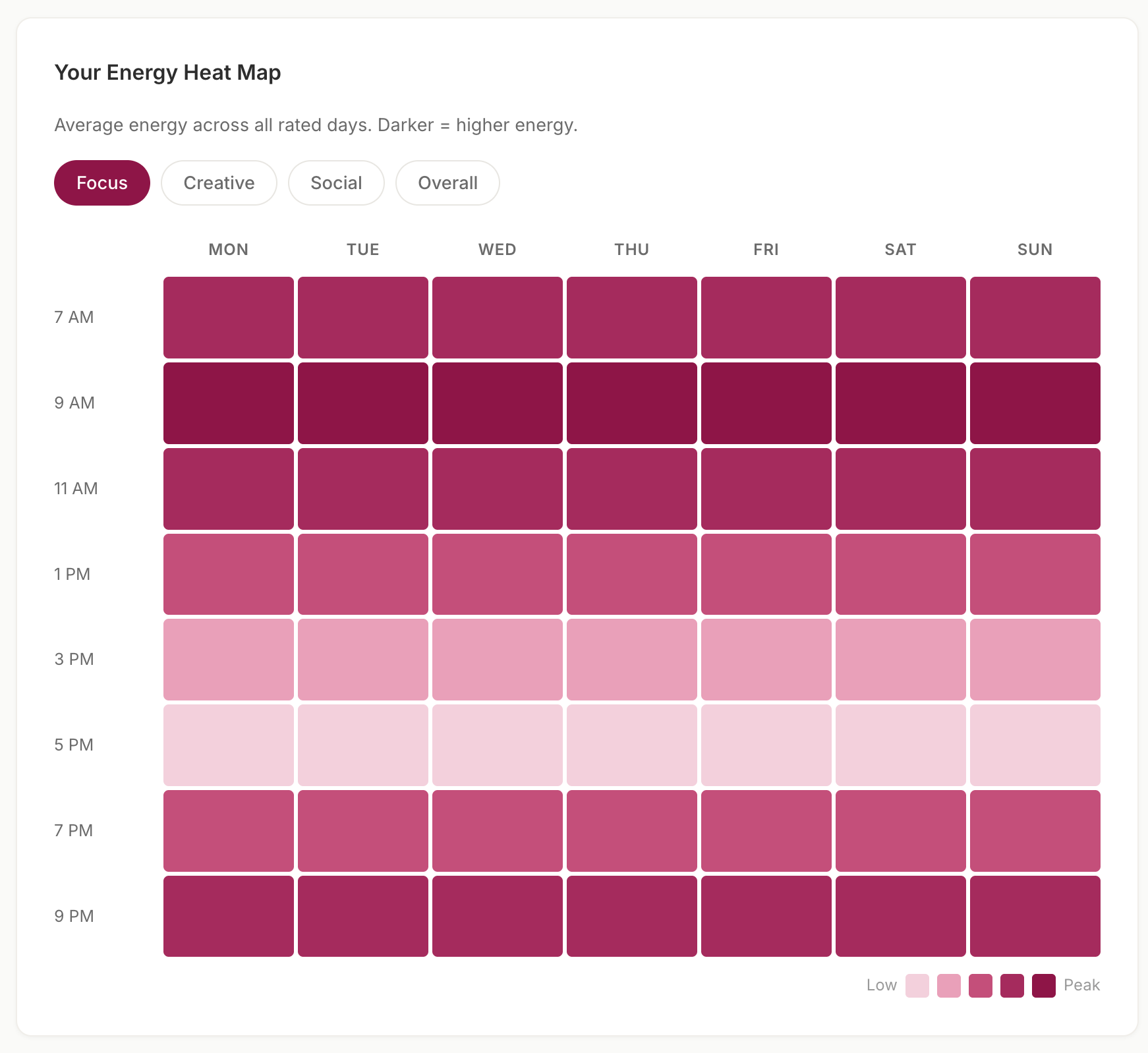
Based on your energy ratings, the tool will create a heat map of your energy patterns.
From there, you’ll enter in your daily tasks, and categorize them using a simple drop-down menu.
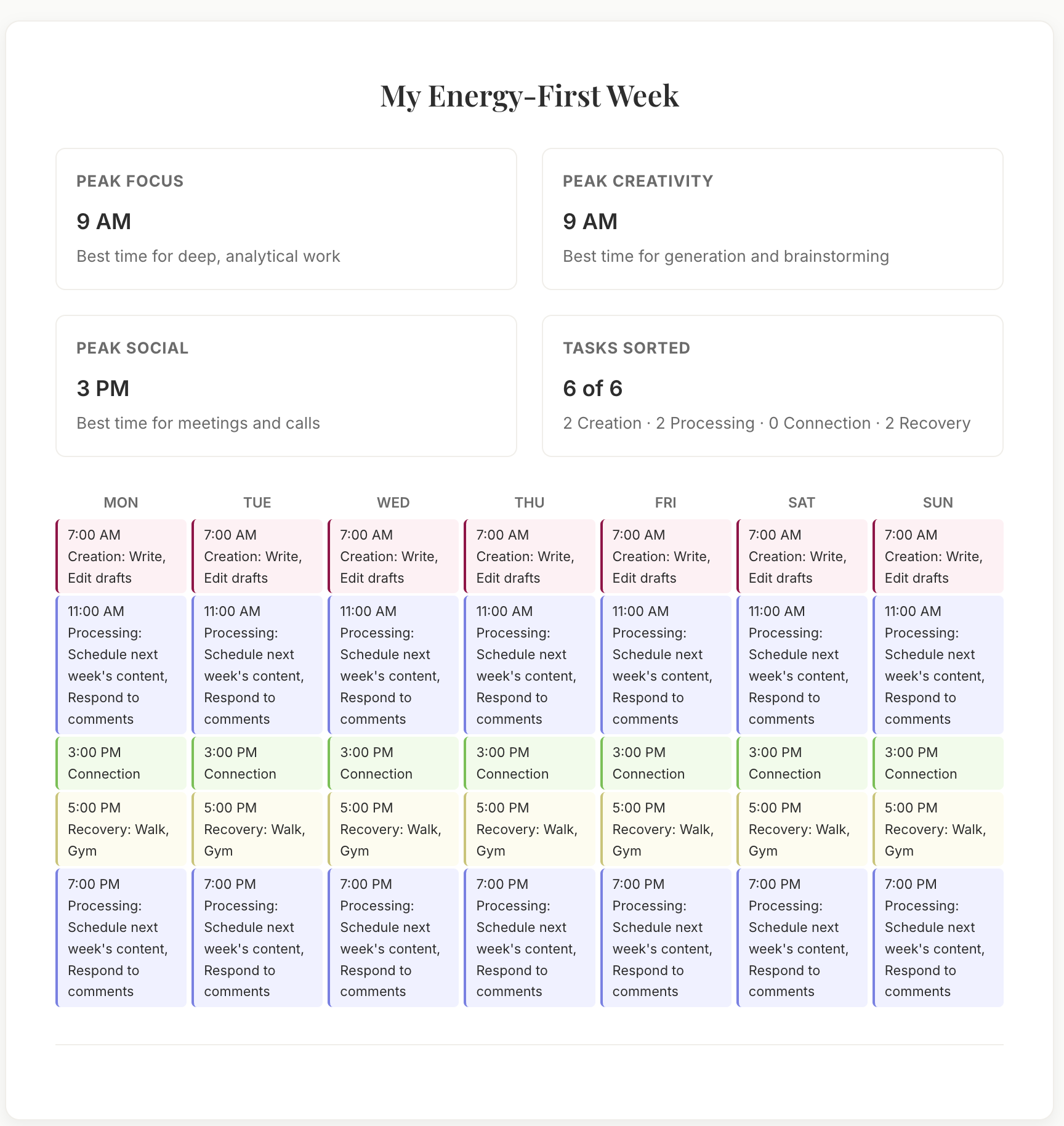
Based on your energy patterns and your categorized entries, the tool will create a daily schedule for you that prioritizes your day and matches your tasks to the appropriate energy level.
*Password is located at the bottom of this page

Below the paywall:
Steps 4 through 7, which includes the complete weekly design template I use (broken down day by day), the rules that protect the structure from falling apart, the Tuesday check-in protocol, the Friday pre-mortem, and what to do when your whole plan breaks. Plus the password to access the energy-first-week-builder above.
Step 4: The weekly design template
Here’s the actual structure I use.