


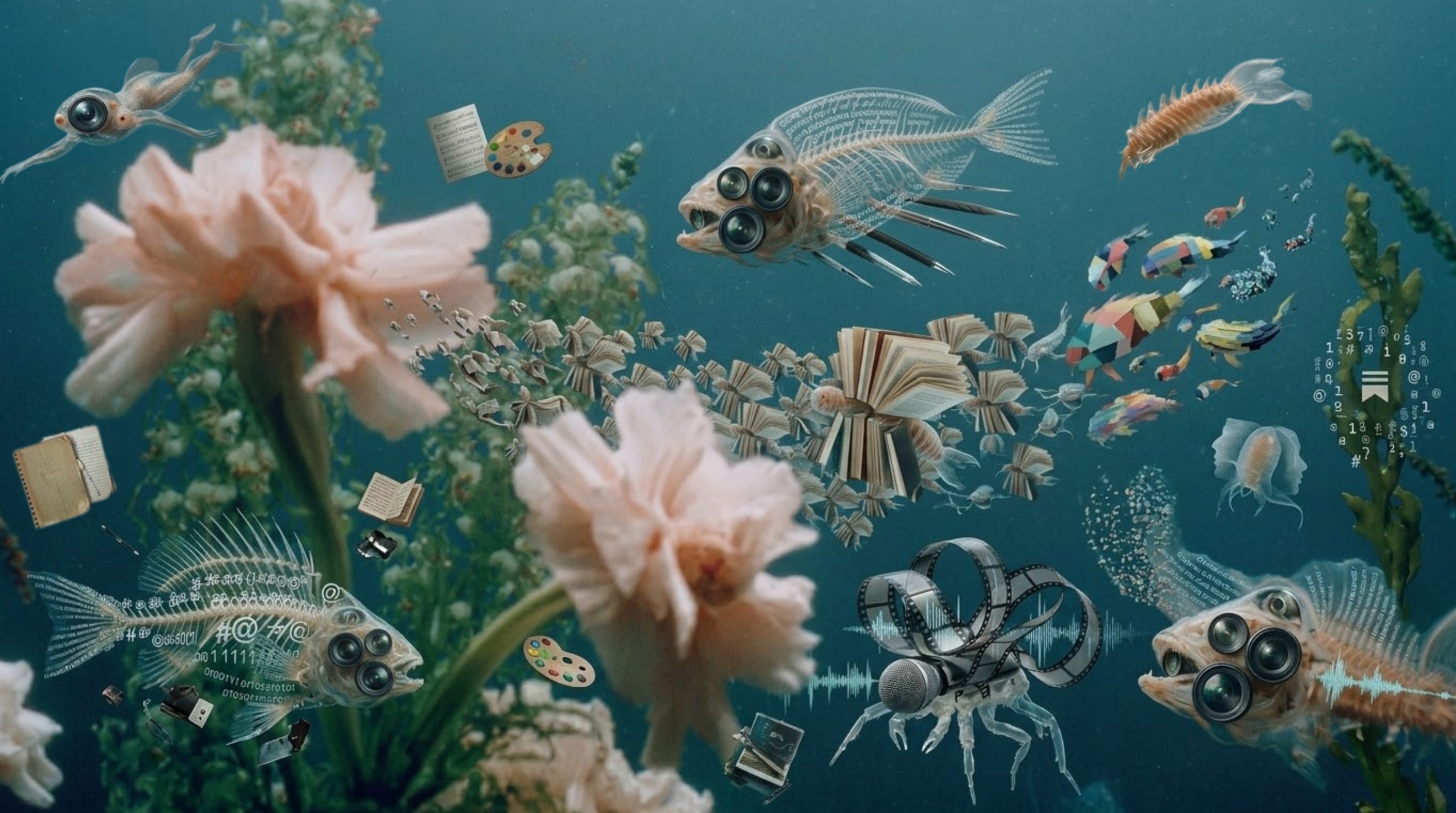
Welcome to the Cambrian Explosion.
Let me say upfront that this essay is really going to piss some people off. It always does when I don’t perform the correct amount of hand-wringing about AI. Apparently having a non-hysterical take on generative tools means you hate artists, you’re a scab, you don’t care about creativity, etc etc etc. I’ve heard all of it. I find it exhausting and historically illiterate, and I’m going to explain exactly why.
And we’ll be skipping the “is AI art really art” debate because that conversation has been running in circles for three years without producing a single useful insight. Whether a machine-generated frame has a soul is a philosophy seminar question. What matters for this essay is what happens economically and culturally when the cost of turning an idea into a finished visual product drops by 90 percent.
Every major creative tool in history has had its doomers. When the printing press arrived, scribes warned that mass-produced text would destroy the sacred craft of writing. When photography emerged, painters declared that mechanical image-making was soulless theft. When the Impressionists dragged their easels outside and painted in open air, the academy treated it like a moral failure. When the digital camera democratized photography, professionals predicted the death of the craft. When YouTube arrived, the industry said it would never produce anything worth watching. (Tell that to Mr Beast.) They were all embarrassingly, obviously, historically wrong, and the people making the same argument about AI right now are going to look exactly the same in ten to twenty years. Certain they were protecting something, and totally blind to the fact that they were just afraid.
I’ve used AI tools constantly, for almost everything, for over three years now, which means I’m watching this acceleration from the inside rather than theorizing about it from a comfortable distance. And what I can tell you is that this isn’t stoppable. There’s no version of events where the cost of turning an imagination into a finished visual product doesn’t keep collapsing. There’s no timeline where the gatekeepers get their moat back. The only question worth asking is where this is actually heading, and that’s what this essay is about.
First, the concession.
AI is taking jobs in Hollywood, not eventually, but right now. Entry-level VFX work, storyboarding, rotoscoping, background generation, you name it, are getting automated and the people who held those roles are feeling it. The British Film Institute flagged it in 2025. The World Economic Forum projected that technology would displace 92 million roles globally by 2030, while creating around 69 million new ones, which is a massive reshuffling rather than a simple loss. But the pain is real and it deserves acknowledgment rather than being waved away. So, acknowledged.
But to understand why what’s coming actually matters, you first have to understand what’s broken about the system it’s disrupting, because the argument isn’t just that AI is arriving, it’s that the thing it’s replacing was already failing us. And nowhere is that failure more obvious than on your couch at nine o’clock on a Tuesday night, scrolling through an endless grid of content and feeling absolutely nothing.
The problem isn’t that there’s nothing to watch.
The complaint you hear constantly, that there’s nothing good on, is technically insane. You have access to more filmed content than any human in history. Multiple streaming services are actively competing to bury you in options, and yet you scroll for forty minutes and rewatch Friends for the ninth time. This isn’t an abundance problem, it’s a quality signal problem, and it has a very specific cause.
When a single season of television costs $150 million to produce, the studio can’t afford for it to be strange. It can’t afford to alienate international markets, challenge demographic assumptions, or follow a vision that doesn’t test well with focus groups in Ohio. The financial architecture of legacy entertainment requires broad appeal as a survival mechanism, and the result is content that’s technically competent, visually expensive, and emotionally inert. It was designed by committee to offend no one and, consequently, to move no one.
The current machine organizations (the Netflixes, the Warners, the Paramounts) have spent decades optimizing the human out of the creative process. To mitigate risk at that budget level, they rely on proven IP, recycled tropes, and algorithmic projections of what kept viewers engaged for the first ten minutes of a similar show last year. A brilliant, idiosyncratic script gets purchased, handed to a room of executives, focus-grouped into submission, and sanded down until all of its interesting edges are gone. The final product is polished, loud, and completely hollow.
This is the architecture of the slop, and the slop isn’t just the six-fingered AI cats on your social feed. It’s the $200 million blockbuster that feels like it was written by a committee of accountants in a windowless room in Burbank. It’s the prestige drama that hits every expected beat so precisely that you forget it the moment the credits roll. When a project costs a quarter billion dollars to produce and another hundred million to market, it can’t afford to have an edge. It has to be palatable to everyone from Peoria to Phuket, and in the legacy system, “mass appeal” has always been a polite term for the lowest common denominator.
To be clear, humans have always made slop. Bad art is not a new invention. Shakespeare’s contemporaries were cranking out forgettable plays by the dozen, and for every Monet there were a thousand painters nobody remembers. The slop has always been there. What the modern studio system managed to achieve, somehow, is making the expensive stuff the most mediocre of all.
The deeply counterintuitive truth here is that AI is actually the solution to this problem, not the cause of it. By collapsing the cost of production, we’re finally decoupling vision from capital. When a screenwriter can generate a high-fidelity series from their bedroom without needing a $50 million permission slip, they no longer have to care about the masses. They can care about the story.
Enter: The Cambrian explosion.
Around 540 million years ago, complex life on Earth went from sparse to explosively diverse in a relatively short window. New body plans, new defense mechanisms, entirely new strategies for existing, all appearing seemingly out of nowhere. Biologists call it the Cambrian explosion, and it was the most generative moment in the history of life on this planet.
We’re standing at the beginning of something equivalent in content.