



Earlier this week while I was out running errands, I saw the same woman at three different places. Once at the coffee shop, once at Target, and again at the Post Office. Except it wasn’t the same woman, it was three different women who looked so similar I had to double-take each time. Same overfilled lips, same contoured cheekbones, same brow lift pulling everything slightly upward, same long blonde hair extensions falling in identical waves. Same face, same hair, different bodies, walking around like they’d all been produced at the same factory.
The Instagram face is no longer an online phenomenon. It has escaped the internet and colonized actual physical reality. It’s at brunch, it’s at the nail salon, it’s at Target. There’s a specific woman now (and you know exactly who I’m talking about) and she’s everywhere, multiplying, a copy of a copy of a copy of something that was already artificial to begin with.
And the thing that gets me, beyond the sameness, is the sheer amount of maintenance this look requires. The filler touch-ups every six to twelve months. the Botox every three to four months, the hair extensions that need moving up as your real hair grows, the lash extensions every two to three weeks, the nails, the brows, the facials. We’re talking about a part-time job’s worth of appointments just to maintain a face, and somehow millions of women have decided this is a reasonable way to spend their time and money—not to look like themselves, but to look like each other.
I’m not saying these women look bad… some of them look great, in a very specific way. But they look great in the exact same way, which starts to feel less like beauty and more like a uniform.
People have been talking about “Instagram face” for years now—the specific combination of features that filters enhance and fillers create. It’s been analyzed and criticized and memed to death, but knowing the phenomenon exists doesn’t make it less strange to actually see, over and over again, women who’ve voluntarily made themselves look more like each other and less like themselves.
★
There’s a video going viral right now that captures this better than anything I could describe.


A young woman who is genuinely, objectively beautiful, sits down for a “glam” makeover. In the before, she’s striking in the way that actually stops you in your tracks when you see someone who looks like her. Clear skin, natural brows, a face that looks like it belongs to a very specific person. The kind of face you’d remember. Then the transformation happens. Contour, highlight, overlined lips, lashes, the whole protocol. And when the reveal comes, millions of people had the same gut reaction… she looks… worse. Not ugly… just less? Less distinctive, less alive, less her. She went from looking like someone to looking like everyone.

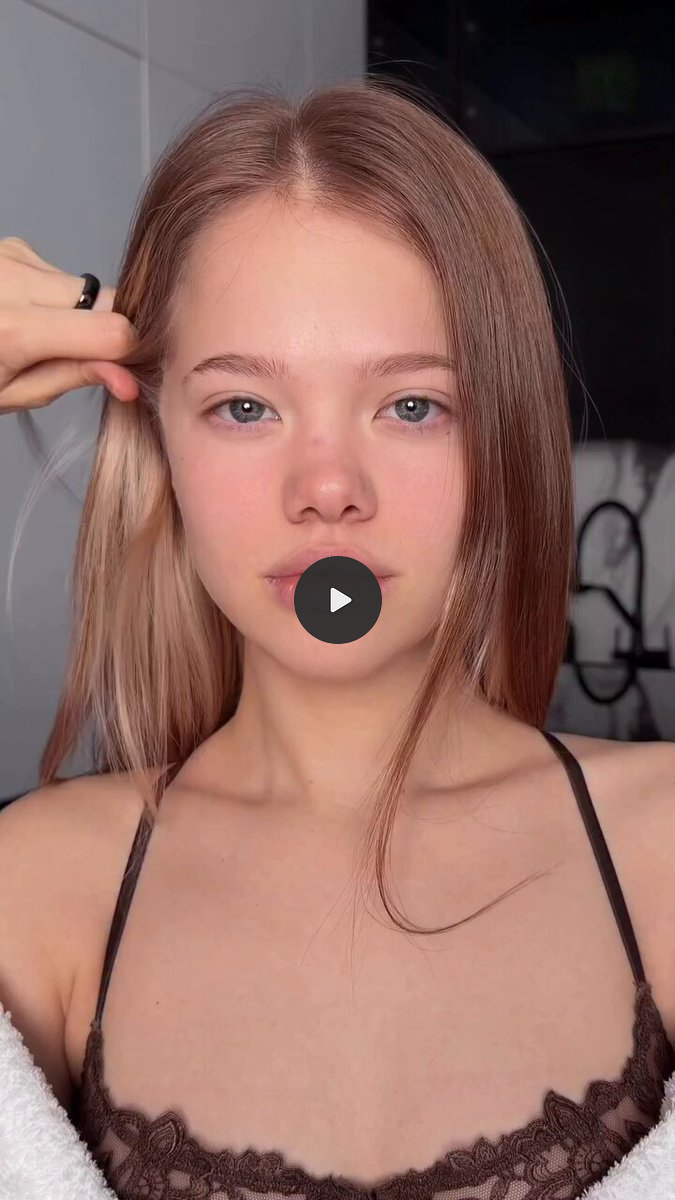
The comments are full of people trying to articulate what they hate about it, and most of them land somewhere around “she looked better before” without being able to explain why. But there is a why, and it’s not just aesthetic preference. It’s actually neurological.
Your brain has a dedicated region for processing faces—the fusiform face area—and it doesn’t evaluate features the way a makeup artist does, which is one at a time. It reads the whole gestalt. It sees the relationship between every feature simultaneously. The subtle asymmetries, the micro-proportions, the way light falls on bone structure that hasn’t been optically restructured with bronzer. Your brain processes a natural face holistically, as a unified identity, and it does this with remarkable speed and emotional fluency. You see a face and you feel something about that person before you’ve consciously registered a single feature.
Heavy contouring and filler disrupt this process at a fundamental level. When you reshape the apparent bone structure with shadow and highlight, you’re feeding the fusiform face area contradictory information—the geometry says one thing, the texture says another, and the micro-movements of actual muscle and skin underneath don’t match the sculpted surface. Your brain flags the discrepancy even when your conscious mind can’t name it. The result is that uncanny flicker of something’s off that people experience when they meet someone whose face has been heavily modified. You’re attracted to the features in isolation. The lips are full, the cheekbones are sharp, the skin is smooth, but the face as a whole doesn’t cohere, and some part of you registers that as untrustworthy, or at least unreadable.
There’s a reason for this. Humans evolved to extract enormous amounts of social information from faces. Trustworthiness, emotional state, health, age, intention—we read all of this in fractions of a second, and we do it through micro-expressions, subtle asymmetries, and the natural play of muscle under skin. Symmetry is attractive, but only up to a point. Perfectly symmetrical faces, when generated in studies, are rated as less attractive and less trustworthy than faces with natural slight asymmetries. We’re not wired to find perfection beautiful. We’re wired to find humanness beautiful, and humanness is, by definition, a little bit irregular.

This is what the glam transformation destroyed. The before face had all its irregularities intact. The slight unevenness that makes a face legible, the natural shadows that let your brain build a three-dimensional model of an actual person. The after face had been flattened into a two-dimensional template. Every contour was placed according to a formula rather than following the actual architecture underneath. The result was a face optimized for a photograph but degraded for the far more complex task of being perceived by another human being in real life.
At some point, unfortunately, we stop reading these types of faces as a person and start reading them as products.
★
I know what that perceptual disruption feels like, because I’ve experienced it from the inside… not as a viewer, but as the face.
About five years ago, I experimented with lip filler. I’ve always had an uneven top lip where one side was slightly more plump than the other, and I thought it made my face look asymmetrical (hello insecurity that practically no one else noticed!) So I went to get it evened out. I had justified this to myself as “I’m just balancing it out.”
Well, the woman messed up. She put more filler in the side that was already bigger. I should have just accepted my fate and stopped the whole process right there.