



In Rome, when a general was granted a triumph (the highest military honor, a procession through the streets with spoils and captives and the roar of a city at his feet), a slave is said to have stood behind him in the chariot. The slave had one job. While the general wore his gold-embroidered toga and held his laurel crown, the slave leaned in and whispered, over and over:
Memento mori.
Remember, you will die.
Not in the abstract or as theological housekeeping. The man accepting the adoration of an empire, the man who in this moment is closer to a god than any mortal has a right to be, will rot. His bones will powder. The slave’s job was not to ruin the celebration but to make it mean something, because a triumph experienced without the knowledge of death is just spectacle. It’s noise shaped like glory, and it will evaporate from memory the way all unanchored pleasure does.
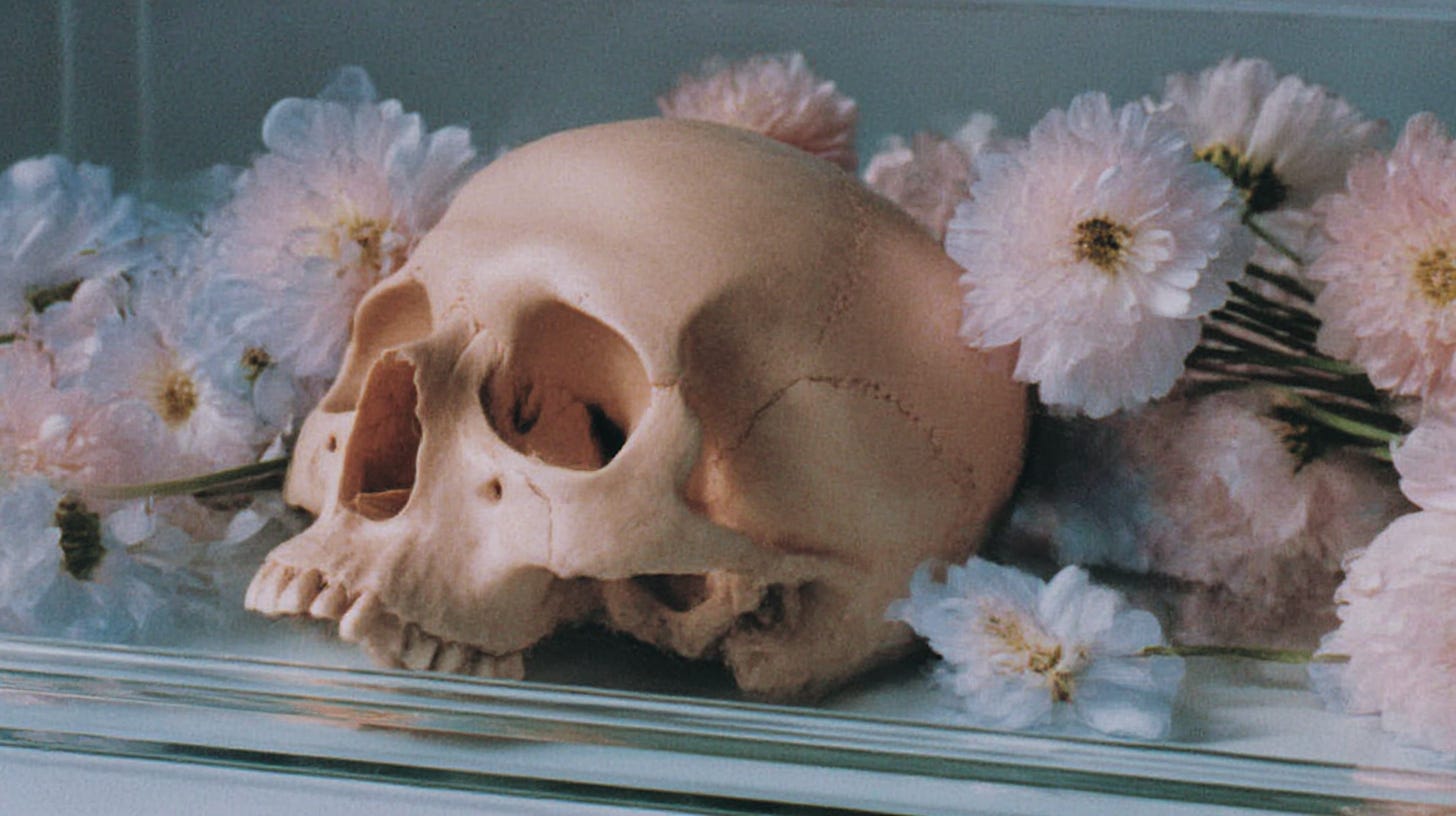
The tradition didn’t stay in Rome. It seeped into the walls of European culture for centuries. Vanitas paintings (mostly Dutch from the 16th and 17th centuries) filled canvases with skulls nestled among flowers, hourglasses beside ripe fruit, candles burned halfway down. The message was always compositional: beauty and decay held in the same frame. Because the artists understood that beauty requires the frame of death to register as beauty at all. A flower that never wilts is plastic.
Monks kept skulls on their desks the way we keep calendars on ours, except the skull was more honest. A clock tells you what time it is. A skull tells you what time is for. It sat there while they copied manuscripts and prayed and ate their bread, and its presence reorganized everything around it without moving, the way a magnet silently reorients iron filings into a pattern they couldn’t find on their own.
The Latin itself is worth sitting with. Memento is an imperative, a command and not a suggestion, and it’s in the future-active form: remember. The grammar assumes you will forget. Forgetting is the default state, and death awareness isn’t something you acquire once and keep forever like a vaccination. It’s a discipline, something that has to be practiced and re-practiced because everything in your environment works to undo it. The Romans understood this. The Dutch understood this. The monks understood this. Every serious civilization that has ever existed has built some mechanism for forcing its people to confront the fact that they’re temporary, because without that mechanism, people drift. They accumulate things, they mistake comfort for meaning and motion for progress, and they sleepwalk through the one life they were given. This is exactly what every empire’s comfortable class has always done, and it’s exactly what we’re doing now.
Except the thing undoing our death awareness today is more efficient than anything a Roman general or a Dutch merchant ever encountered. It fits in your pocket and you tap, swipe, and click it roughly 2,617 times a day1. And it has accomplished something that no empire, no religion, and no ideology has ever fully managed: it has made the feeling of time passing almost imperceptible.
The brain’s oldest bargain.
Every living organism moves away from death. Bacteria swim from toxins. Insects flee shadows. Deer bolt at the snap of a branch. This is not remarkable. What’s remarkable is that humans are the only species that knows it’s going to die long before it happens, and has to figure out how to keep functioning anyway.
This is the central problem that three social psychologists, Sheldon Solomon, Jeff Greenberg, and Tom Pyszczynski, spent decades studying under the banner of Terror Management Theory (TMT). Their work, rooted in the cultural anthropologist Ernest Becker’s The Denial of Death, starts from a deceptively simple premise: the awareness of mortality is so psychologically destabilizing that human beings have built the entirety of culture, religion, ideology, and identity as a buffer against it. Every symbolic system we’ve ever constructed, from the Egyptian pyramids to your LinkedIn profile, serves at least in part as what Becker called an “immortality project,” an attempt to extend ourselves beyond biological death through legacy, meaning, reputation, or the belief that we belong to something that will outlast our bodies.
The empirical findings are striking. In hundreds of experiments across dozens of countries, researchers used what they call “mortality salience” interventions, essentially just asking people to briefly contemplate their own death, and then measured the downstream effects on behavior and cognition. The results were remarkably consistent. When people are reminded that they’re going to die, their priorities reorganize. They become less materialistic, they report stronger connection to their values, they allocate time differently, spending more of it on relationships and experiences that feel genuinely significant rather than merely urgent. They also become more defensive of their worldviews and harsher toward those who threaten them, which is worth acknowledging because death awareness is not a clean or universally pleasant force. It’s a disruptive one. It doesn’t make you nicer, it makes you realer, which sometimes looks like deeper love and sometimes looks like tribal hostility, depending on how psychologically integrated you are when the awareness hits.
But here’s the part that matters for this essay: the brain does not want to stay in that state. Mortality salience is physiologically and cognitively taxing because it floods the system with cortisol, activates the anterior cingulate cortex (the brain’s conflict-monitoring system), and essentially forces the organism to confront a problem it cannot solve. You are going to die. There is no action item. The brain hates unsolvable problems because it evolved to conserve energy and resolve threats, and a threat that can never be resolved is, from a neurological standpoint, an open wound that never heals. So the brain suppresses it. Constantly. Automatically. Through what psychologists call “proximal” and “distal” defenses. First by pushing the thought out of conscious awareness entirely, and then by reinforcing whatever cultural worldview makes you feel like your life has meaning and permanence.
