


TL;DR: don’t bullshit yourself in 2026. You can do better. You deserve better.
Additional resources for a more productive and abundant 2026:
How to audit your year (without lying to yourself)
What to do right now if you want 2026 to actually matter
How to build a super simple habit tracker (in 15 minutes or less)
A no-bullshit guide to living a high ROI life
→ Conscious Creation kicks off January 5th!

How to stop bullshitting yourself in 2026.
There’s an old story about Diogenes, the Greek Cynic philosopher who allegedly walked around Athens in broad daylight holding a lit lantern. When people asked him what he was doing, he’d hold the lamp up to their faces and say, “I am just looking for an honest man.” It was a piece of performance art designed to mock the hypocrisy of the city. If Diogenes were alive today, I don’t think he’d be walking around looking for other people, I think he’d be scrolling January timelines, holding the lantern up to people’s New Year’s resolutions, looking for an honest one.
We love to talk about liars. We obsess over politicians lying to the public, corporations lying to the media, and ex-partners lying to us. But we rarely talk about the most dangerous and consistent liar in our lives, which is the voice in our own heads. We treat self-deception like a glitch, but it’s actually our default operating system, and unlike the lies other people tell us—which we can usually spot because they’re clumsy—the lies we tell ourselves are elegant and convenient. And worst of all, they almost always sound like “reason.”
You know exactly what I’m talking about. It’s the moment you convince yourself you’re “too busy” to work on your project, even though you just spent ninety minutes doomscrolling. It’s the friend who claims they “hate drama” while actively being the epicenter of every conflict in the friend group. It’s the internal monologue that says you’re “just being realistic” about your dreams when what you actually mean is, “I’m terrified of trying and failing.”
Nowhere is this more visible than at the start of the year. “This is the year I get serious.” “This is the year I focus.” “This is the year I become my best self.”
These aren’t goals, they’re aspirational slop—specific enough to feel virtuous, but vague enough to require nothing of you tomorrow.
And that’s the problem. Most New Year’s resolutions fail for the same reason: they’re declarations without infrastructure. Wanting is mistaken for planning. Motivation is mistaken for capacity. There’s no system, no constraint, and no feedback loop. Just a date on the calendar and a story about who you’re going to be “this year.”
Get in the arena.

The evolutionary art of the self-con.
We don’t bullshit ourselves because we’re stupid; we do it because it’s adaptive. Evolutionary biologist Robert Trivers has a theory that self-deception evolved to make us better at deceiving others. If you consciously know you’re lying, you have “tells”—you sweat, you hesitate, your voice cracks. But if you can successfully convince yourself that the lie is true, you can sell it to the world with total conviction.
We are masters of cognitive dissonance. Our minds will do essentially anything to preserve comfort over truth. We engage in motivated reasoning, where we decide what we want to believe first (”I shouldn’t break up with him”) and then go out and find the evidence to support it (”He did do the dishes that one time in 2021”).
I spent years telling myself I was “overworked” and “burnt out,” which sounded like a valid, responsible excuse for why I wasn’t writing more often. The truth, which was much harder to look at, was that I was avoiding the work that mattered because I didn’t know if I was good enough to do it. It wasn’t burnout, it was fear. It was imposter syndrome. It’s the Roman Roy from Succession strategy: insisting you “don’t care” about anything because caring opens you up to pain. Or BoJack Horseman, which is essentially a six-season documentary on the pristine architecture of self-bullshit.
The taxonomy of lies.
Once you start looking for this, you realize that personal bullshit usually comes in four distinct flavors.

First, you have The Noble Excuse. This is the bullshit that sounds virtuous. You tell yourself, “I just want to help,” when you’re actually overstepping boundaries to soothe your own anxiety. You say, “I’m protecting my peace,” when you’re actually just avoiding a difficult conversation. Seneca wrote about this almost two thousand years ago, pointing out how often we disguise our procrastination as “preparation” or “virtue.”

Then there’s The Fake Constraint. This is the belief that you simply can’t do something because of an external factor: money, time, childhood trauma, the economy, or Mercury being in retrograde. The Stoic philosopher Epictetus said, “Men are disturbed not by things, but by the view they take of them.” A fake constraint is a view pretending to be a fact.
See also: Most of your limitations aren’t real and you can actually just do things.

Third is The Identity Alibi. This is when we use a fixed idea of ourselves to get out of doing things. “I’m just the type of person who is bad at math,” or “I’m an anxious attachment style,” or “I’m a perfectionist.” William James warned against the “habitual self,” noting how quickly our identities calcify into prison bars. We use these labels as permission slips to stay stagnant.

Finally, there’s The Noble Complexity. This is catnip for smart people. It’s when you over-explain a simple truth to avoid acknowledging it. You aren’t “navigating a nuanced emotional ecosystem regarding your career pivot”; you’re scared to quit your job. It’s the Kendall Roy method of using a thousand business buzzwords to avoid saying, “My dad hurt my feelings.”
January is the high holy season of Noble Complexity. People don’t say, “I don’t want to do the work.” They say, “I’m being intentional about pacing myself this year.” They don’t say, “I have no plan.” They say, “I’m staying open to how things unfold.”
Why we protect the lie.
We cling to these narratives because the alternative is terrifying. If you strip away the bullshit, you’re usually left with a demand for transformation. Nietzsche argued that people often prefer familiar suffering over unfamiliar freedom, and he was right. If I admit that my “constraint” is fake, then I have to act. If I admit my “identity” is a construct, I have to build a better one.

Jung called this Shadow work—confronting the parts of yourself that you’d rather keep in the basement. It’s the moment in Rilke’s poetry where the beauty of the statue hits you like a freight train and demands, “You must change your life.” We bullshit ourselves to muffle that demand.
How to catch yourself bullshitting in real time.
So how do you turn the lantern on yourself? You need better testing mechanisms.

This is one of my personal favorites. Nassim Taleb talks about “skin in the game” as the ultimate bullshit detector. If you tell yourself you’re going to start the gym “on Monday,” ask yourself if you’d bet $1,000 of your own cash that you actually will. If you hesitate, you’re bullshitting.

If a friend came to you with the exact same excuse you’re currently using, would you believe them, or would you roll your eyes? This is basically the Socratic method applied to your own ego. Externalizing the logic usually makes the cracks visible immediately.

Bullshit is almost always emotionally convenient. Ask yourself, “What emotional tax am I avoiding by believing this?” Daniel Kahneman wrote extensively about “cognitive ease”—our brain’s preference for thoughts that don’t challenge us. If a thought feels too easy, poke it. Then poke it some more.

Ask yourself, “If I had to act on this today—not ‘someday,’ but right now—would my reasoning change?” This destroys procrastination bullshit instantly. Marcus Aurelius was big on this kind of urgency, constantly reminding himself that he could leave life at any moment. “Someday” is a lie we tell ourselves to feel immortal.
The smart person trap.
Being smart will not protect you from this. In fact, intelligence often makes you better at bullshitting yourself. The smarter you are, the better you are at rationalizing. You can build complex, bulletproof arguments for why you shouldn’t take a risk, or launder your avoidance through eloquence.
Descartes famously noted that the intellect can build perfect castles on nonexistent foundations, meaning you can be brilliant and still be completely delusional about your own life. Smart people often over-research to avoid action. They turn practical problems into philosophical quagmires so they never have to solve them. They’ve read 200 self-help books, but have yet to help themselves.
See also: How to think like the masters
The liberation of calling your own bluff.
The point of all this isn’t to beat yourself up, it’s to get free. Joan Didion famously wrote, “We tell ourselves stories in order to live.” I’d argue that we also tell ourselves stories in order to avoid living. We tell ourselves the story of the Victim, or the Martyr, or the “Too Busy” Executive, because those stories keep us safe from the unpredictability of the real world.
Heraclitus said that “character is fate,” meaning that your habits and your truthfulness are the architecture of your becoming. When you catch yourself in a lie and choose to tell the truth instead, you are literally altering your fate.
Repeat after me:
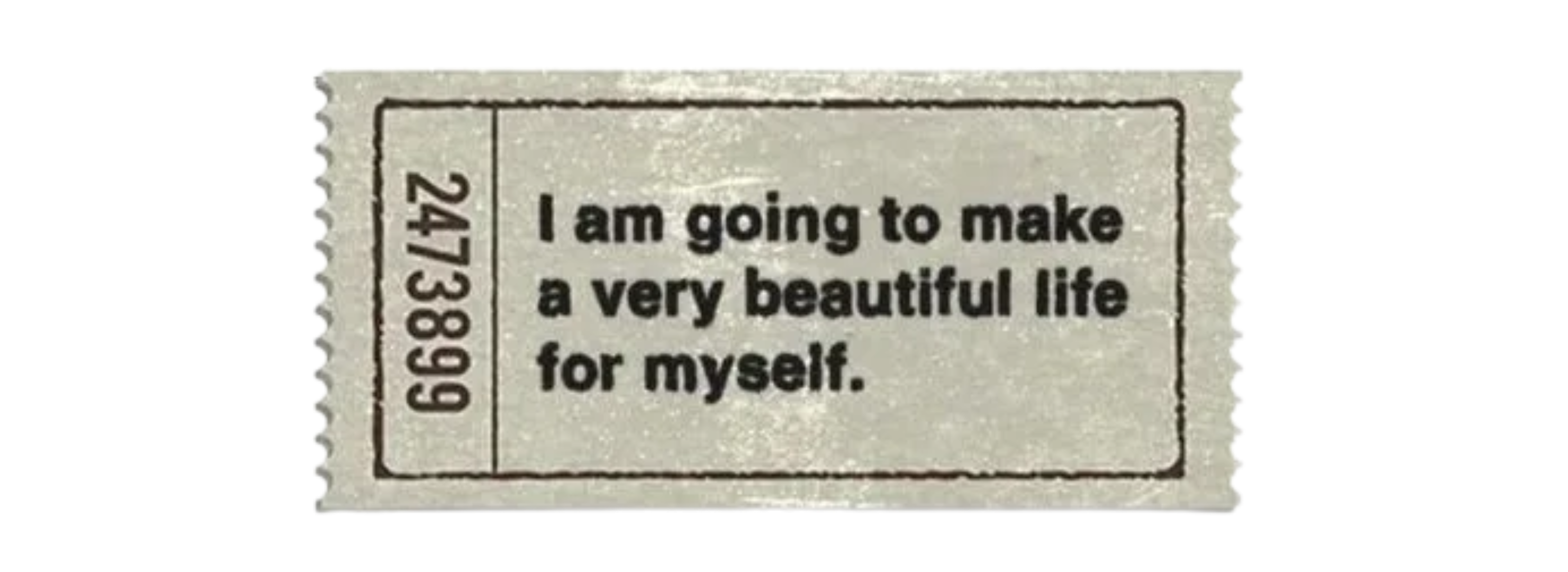
January doesn’t ask you for reinvention, it only asks you for honesty—the boring, uncomfortable kind that sounds like: If this mattered, what would I do today?
Bullshit is the tax you pay for refusing to look at your life directly. New Year’s resolutions are just the most socially acceptable way to keep paying it. If you want this year to be different, don’t start with ambition, start by ending the romance with your own bullshit.
Remember, you are what you choose, and you can choose to stop bullshitting yourself.

As always, thanks for reading with me. If you enjoyed this post, please consider hitting the like button and/or sharing it to help boost its visibility. I appreciate you so much. xo
Another great essay, Stepfanie. Bonus points for the analogous use of Kendall and Roman Roy to hammer home those concepts. A deep dive into the extended Roy family (Tom Wambsgans and Cousin Greg in particular) to futher illustrate your points would be great reading.
For some reason, you’re the only person that I didn’t get pinged for gift subscriptions after I subscribed. Your work is great. I want to give my daughters gift subscriptions. Hopefully, I’m not being obtuse with Substack functionality. Midwest industrial complex is still my favorite article of the year.