



Last week, after I published “How to build a week that doesn’t drain you,” I received some interesting questions about the actual planning process behind my weeks. While I haven’t had a chance to do a deep dive into my ‘philosophy of planning’ yet, I realized there is actually something I can share immediately, which is my Sunday meeting ritual. The 30 minute sit-down I have with myself before each new week. If you’re trying to be more strategic with your time and energy, and prioritize what you’re executing on, maybe this will be helpful for you too.

You would never run a company where nobody checked the calendar until Monday morning. Imagine the CEO showing up and getting blindsided by three meetings he didn’t prepare for, spending the day putting out fires he could’ve prevented, and then wondering why nothing strategic ever gets done. You’d call that company mismanaged. You’d say the leadership was asleep at the wheel.
And yet that is exactly how most people run their lives.
Sunday night arrives and the dread kicks in because an unknown blur of obligations and half-remembered commitments bears down on you like weather you didn’t check the forecast for. So you cope and you scroll and you “relax” in a way that’s actually just avoidance. And then Monday hits and you’re already behind, because behind is where you started.
A lot of people approach this as if it’s a discipline problem, but I’m of the belief that it’s actually just a simple architecture problem. You don’t have a meeting with yourself, so you never get ahead of the week. Instead, you just get dragged through it.
I started having these Sunday meetings with myself about a year ago, and so far, it’s the closest I’ve come to solving my own architecture problem. It takes about thirty minutes, but the more you do it, the faster you’ll get. It works whether you have a boss or you are your own boss, whether you use a color-coded calendar or a crumbled up receipt, or whether your week is predictable or barely held together with string. What it requires is honesty, a pen or your Notes app (or wherever you keep your notes), and the willingness to look at your life like it’s something you’re in charge of.
Because, I don’t know if you know this, but you are in charge of your life :)
Everyone plans. Almost nobody examines.
There’s a version of Sunday planning that already exists in the productivity canon, and it’s mostly useless. Buy a planner, write down your goals, time-block your calendar, and color-code it if you’re feeling ambitious. These systems have one thing in common, which is, they assume everything currently on your plate belongs there, and the only problem is that it isn’t organized well enough.
In my experience, that assumption is almost always wrong.
Most of what fills your week wasn’t chosen, it’s just accumulated over time. The recurring meeting that stopped being useful six months ago but nobody’s had the balls to cancel, or the obligation you agreed to when you were trying to be agreeable, or that errand you keep doing manually because you never spent twenty minutes finding a better solution, or the social commitment you dread but maintain because you’ve never actually asked yourself why you said yes in the first place.
Your calendar (or your mental to-do list, or whatever passes for your system) is an archaeological record of decisions made by previous versions of you under different circumstances. You keep honoring them like contracts you can’t renegotiate… except you absolutely can.
Most planning systems skip the part where you decide whether things should exist on your plate at all. That’s the part this meeting is for. Before you optimize the schedule, you audit the system that produced it.
Personally, I tend to accumulate tasks and other aspirations quickly, which is why the examination aspect is more important than the planning piece, and is exactly why this works so well for me as part of my overall weekly system. You might resonate with this too. I write something ambitious down and then it carries over week after week after week, without ever getting done. I hang on to it so long it starts to become sentimental. This meeting has become the place where I am ruthless with the decisions of my previous selves, and cancel or delete the things she thought I “should” do.
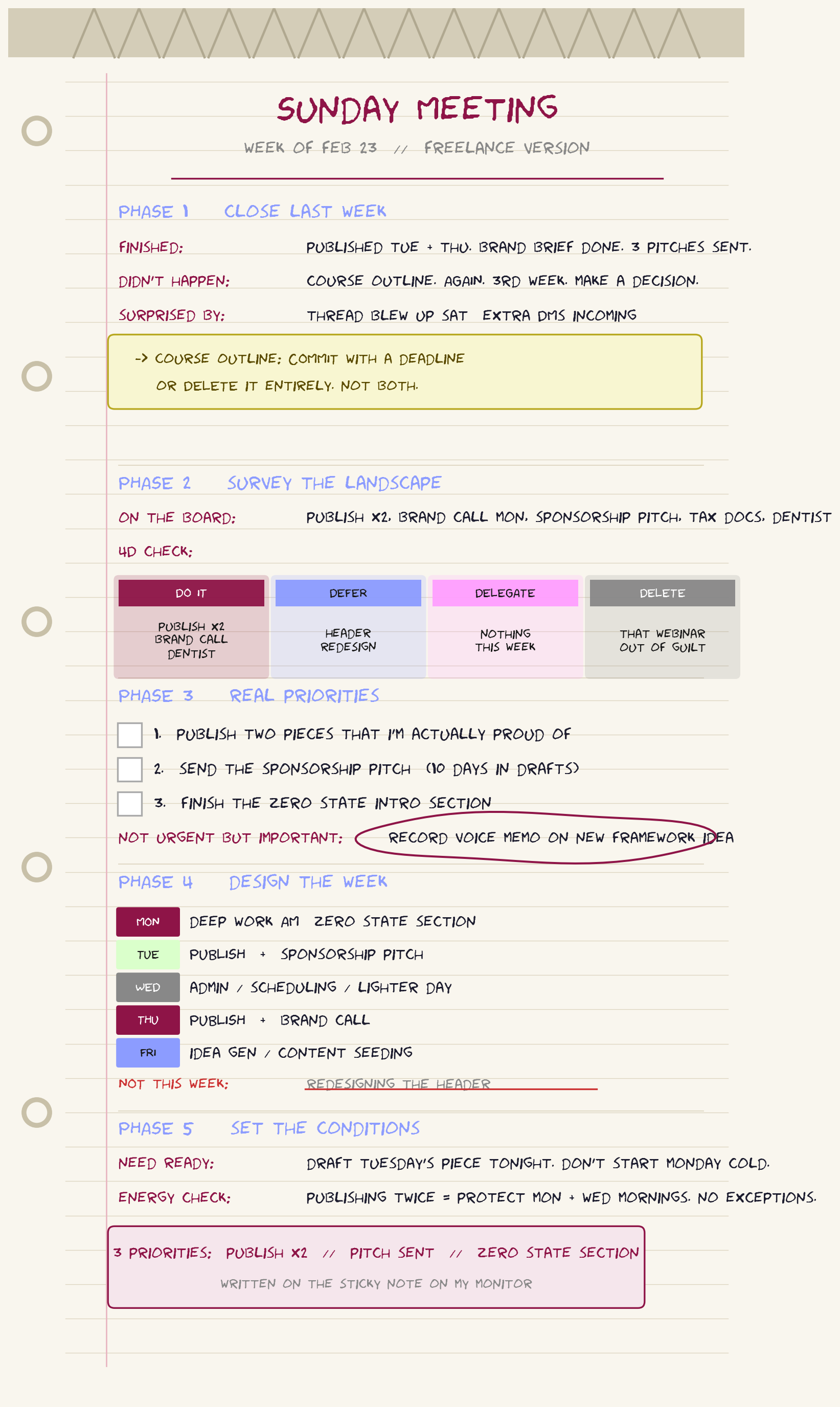
Here’s an example of what you’ll be building in your own Sunday meeting:
Why Sunday. Why 30 minutes. Why every single week.
Sunday works because it sits in the gap between weeks, close enough to the week ahead that you can be specific, but far enough from it that you’re not already in reaction mode. Monday morning is too late because you’re already being acted upon, and Friday afternoon is too early and too contaminated by the week you just survived. Sunday gives you the distance to think clearly and the proximity to act precisely.
Thirty minutes is the constraint, and the constraint is a feature. A protocol that takes an hour won’t survive contact with real life, but thirty minutes is short enough to be non-negotiable and long enough to be genuinely useful. Set a timer for each phase and let it create urgency. Urgency prevents the meeting from becoming an open-ended rumination session where you journal about your feelings and end up scheduling nothing.
The consistency is what makes it work. This has to be a ritual, not just another intention. Same time, same place, same structure, every week. Unanchored intentions have a half-life of about three days, but a ritual with a fixed container becomes load-bearing. It holds weight because it has a shape. You don’t decide every Tuesday whether to go to your standing meeting at work, you just go. This is the same principle applied to your own life, which deserves at least the same structural respect you give your employer.
Before you sit down: what to bring
The setup is part of the ritual. What you need depends on what your week looks like.
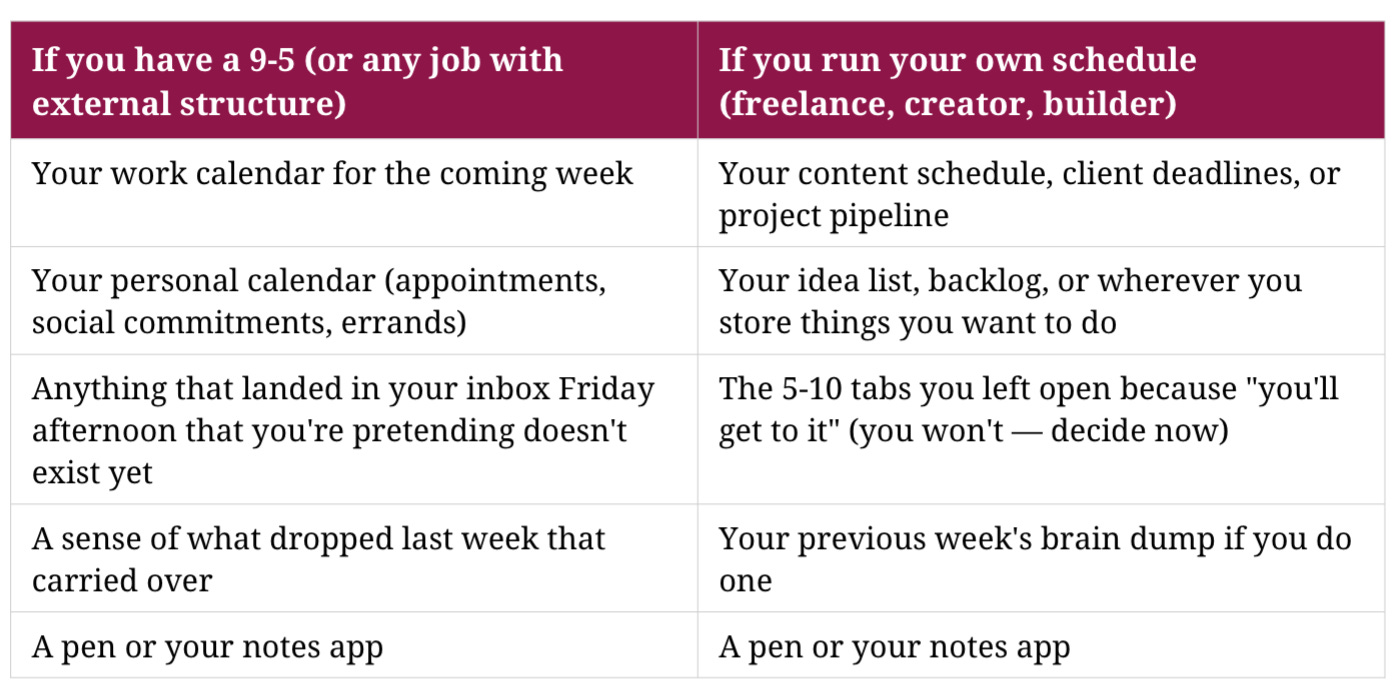
One rule regardless of which column you’re in: phone in another room or on Do Not Disturb. Not face-down on the desk. Another room. You’re not managing your attention in this meeting, you’re designing your week. They’re different cognitive modes and the phone collapses them.
A quick note before we get into the protocol: this meeting is the governance layer on top of whatever structure you already have. If you’ve been using the Energy-First Week Builder, Phase 4 is where that work pays off because you already know which hours belong to which kind of work, and you’re slotting your priorities into the right containers. If you haven’t done the energy audit yet, a slow Sunday is actually a great time. You only need to do it once to get data that changes every week after.

The Protocol: 30 minutes, five phases
Set a timer for each phase. When it goes off, move on.

5 minutes.
This phase is operational, not emotional. You’re not processing your feelings about the week, you’re simply closing open loops so they don’t follow you into the next one.
Three questions, answered fast.
1. What did I complete that I intended to complete?
This is for calibration. You need an accurate read on how much you actually get done in a week so you can plan the next one realistically. Most people overestimate their weekly capacity by about 40%, which is why most Sunday plans fail by Wednesday.
9-5 example: “I finished the client proposal, made the dentist appointment, and got to the gym twice out of three planned times.”
Freelance example: “I published the Tuesday essay, sent two pitch emails, and finalized the brand partnership brief. Didn’t touch the course outline.”
2. What didn’t get done, and why?
This is the more important question. “Didn’t get done” has a reason, and the reason matters. Was it genuinely deprioritized because something more important took its place? Did it drift because nothing forced it forward? Or did you just not want to do it?
If something has appeared on this list three weeks in a row, it needs a decision right now: commit to it with a specific plan, or kill it. Perpetual deferral is its own answer… you don’t actually intend to do it, you just haven’t admitted that yet.
3. What surprised me?
Surprises reveal planning gaps. If your week was full of things you didn’t see coming, that’s structural. Either your environment is genuinely unpredictable (rare) or you’re not scanning far enough ahead (common). Recurring surprises in the same category are a pattern, not bad luck.

5 minutes.
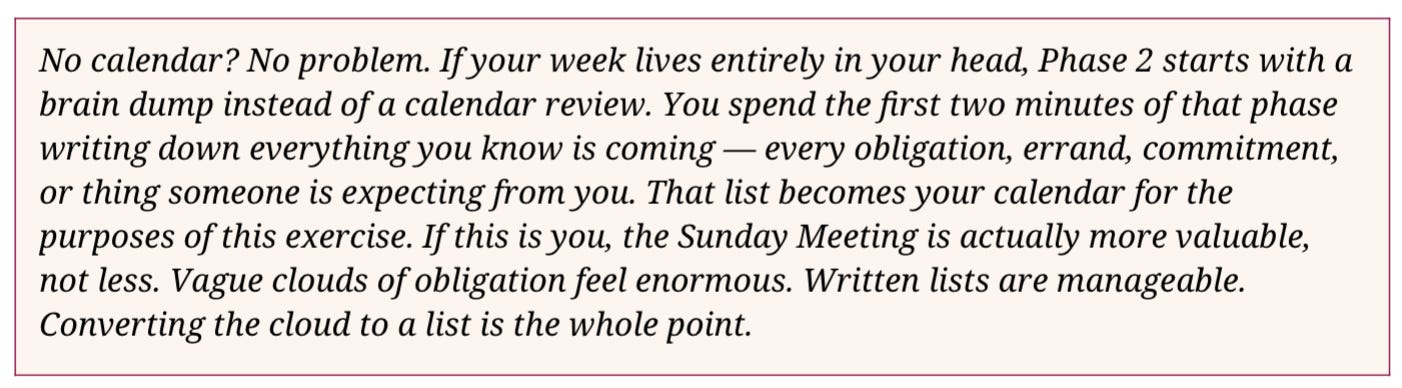
Pull up whatever holds your week, whether that’s your calendar, your notes app, your task list, or the list you just wrote in the no-calendar version. Look at everything on the board without starting to schedule yet. The question is, what’s actually here?
Get it all visible. Most people carry their week as a vague cloud of anxiety rather than a concrete map, but when you see it written out, it is almost always more manageable than it felt when it was floating around unexamined.
Then ask: what shouldn’t be here?
For each item, run it through four buckets: