


I’ve tried to build a fashion brand three times. I’ve spent tens of thousands of dollars on it across those attempts, told my circle I was launching more times than I want to admit, purchased actual inventory, and still never managed to cross the line into having a live store with shoppable products. The last attempt got far enough that when it collapsed I had product to deal with, which I handled by passing off to a friend to sell at farmers markets, because that felt marginally less like defeat than having to donate it. I’m not going to pretend that isn’t embarrassing. When you tell the same people the same dream enough times and keep coming back empty-handed, there’s a point where the announcement itself becomes a joke.
So I want to be clear about something before I explain why I’m trying again: this isn’t another empty announcement. As of yesterday, the site is live. People can actually buy things. That has never been true before, and the reason it’s true now isn’t that I finally found the courage I was missing or got my head right or decided to stop being afraid. It’s that the specific bottlenecks that killed every previous attempt have genuinely collapsed, and I’ve spent enough failed attempts learning exactly where those bottlenecks were to recognize when they’re gone. And believe me when I say… they’re gone.
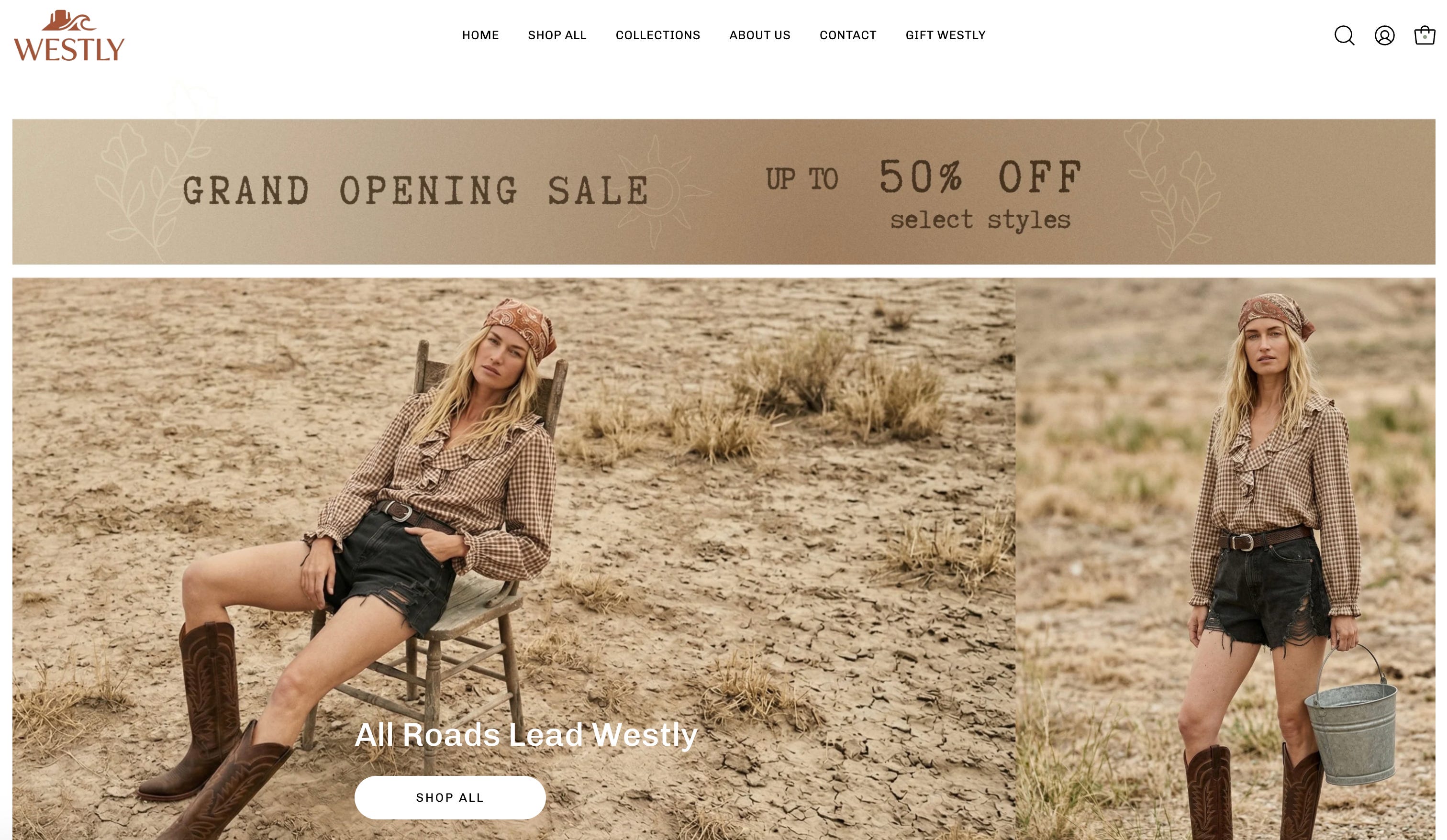
For most of modern history, starting a brand required a long chain of capabilities to line up at once. You needed a storefront, payment infrastructure, suppliers, logistics, photography, and reach, and if any single link in that chain broke, the whole thing broke. The advice to “just start” always sounded simple coming from people who were already on the other side of it. In practice, there were gates everywhere, and most of them were expensive and slow. But that world has been quietly dismantling itself for years.
Shopify now exists. That sounds almost too obvious to be worth saying, but the implications are enormous. A single person with a point of view can now have a functioning storefront with payment processing and product pages in an hour. Then sourcing got democratized. Platforms like Faire and FashionGo let an independent operator with a business license access wholesale vendors across the world that would have been completely opaque a decade ago. Access that once required relationships, industry connections, and serious capital now largely requires logging in. And when access widens like that, curation becomes the differentiator, which happens to be the exact game I’ve always wanted to play.
I want to be honest about where I’ve gotten stuck before, though, because it wasn’t always infrastructure standing in the way. The last time I tried to build this, I went further than most people even know. I didn’t just want to curate wholesale product, I wanted to manufacture my own. I went to LA, worked directly with a manufacturer, designed pieces, had prototypes made, and for a while it felt genuinely close. And then reality arrived in the form of minimum order quantities. To produce even a handful of styles at the required scale was going to cost nearly $100,000, and that was just for the privilege of learning whether I’d gotten the product right. I didn’t have that kind of cash to commit before a single customer had even weighed in, so the whole thing came to a stop. What’s different now isn’t just that costs are lower, it’s that the path itself has changed. I can test before I commit, and I can build a real feedback loop before making irreversible bets, and that changes the calculus entirely.
But the bottleneck that actually killed me every time wasn’t the store or the sourcing. It was actually the image. When you sell on the internet, you’re selling an image before you’re selling a product. You’re selling the feeling of ownership, the version of yourself you might become, the emotional weight a garment carries before anyone’s touched it. I’ve known how high that bar is for a long time, and not just theoretically. I’ve been in something close to half a million photographs. I spent years as a content creator with a significant audience, was the face of a brand for almost a year, and at various points was also the one directing the shoots, booking the models, and doing the photography myself. That combination taught me more about building a brand than almost anything else could have, because I had to understand every layer of the production at once. I learned how a product gets styled, what a story costs to build around it, where imagery breaks down and why, and what it actually takes to make someone feel something about a piece of clothing they’re seeing on a screen.
I also came away knowing exactly how unsustainable that process is for a single operator trying to build something from scratch. To take a garment from a poly bag and turn it into something that reads as desire rather than inventory requires the right model, location, styling, light, pose, crop, and retouching, done consistently, at a standard that clears the bar of the internet. Every time I tried to build a brand before, that’s where I ran out of runway. And it wasn’t because I didn’t know what I wanted it to look like, because I definitely knew. It was because producing it at that level cost more than I could justify before I had any revenue to justify it with.
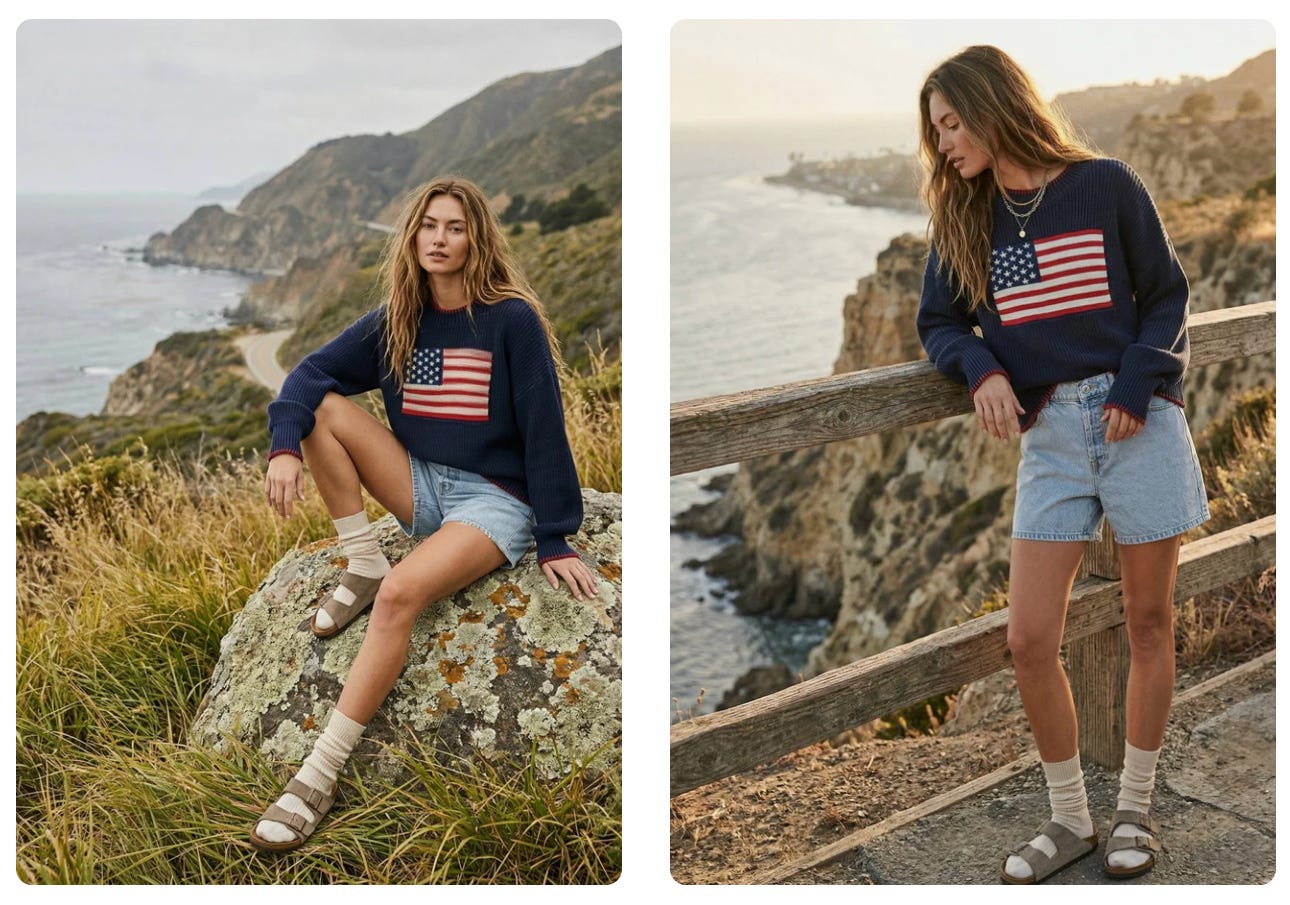
So here’s the thing I didn’t expect to ever say: I can’t take photos better than AI can now generate them, and I can’t model photos better than AI can generate them either. That’s a hard pill to swallow when you know exactly how much craft goes into the human version of this work. But the shift has happened, and the implications go beyond just cost savings. What collapses isn’t just the budget, it’s the entire cycle time. Someone with taste can now move at the speed of taste. I can go from product to imagery to storefront to live test without waiting on ten other people and a four-week (minimum!) production window.
I know that’s not a neutral thing to say right now, but I’d rather be honest about the tools I’m using than perform ambivalence I don’t actually feel. I understand why people are uneasy about it. But I’m not. (If you want the longer version of why, I wrote that last week.)
This changes who gets to participate in this industry in a fundamental way.
It also changes what the real constraint becomes, because when the mechanical barriers lower, the remaining ones get more human. Taste. Curation. Judgment. The ability to know what should exist before the data fully proves it. I’ve thought a lot about why so many stores feel flat and generic right now, and I think it comes down to authorship, or the absence of it. Most brands aren’t really authored anymore, they’re just assembled by disconnected teams, each doing their job reasonably well, but collectively sanding off the point of view in the process. The merchant is in one room, the creative team is in another, the analyst is in another, and by the time a product has passed through enough hands, whatever made it interesting has usually been optimized away. What modern infrastructure and AI tools unlock is a world where a single curator can maintain a coherent point of view across more of the stack, where taste can move at the speed of feedback, and where the loop between what I see in my head and what a customer can actually buy is genuinely short. I think brands built that way are going to be better, not just faster. And as such, I believe this is the future of ecommerce.
When people weigh the cost of starting a business, they usually think about downsides like money, time, or the embarrassment if it doesn’t work. Those costs are real. I know because I’ve paid them, more than once. But the cost of not starting has a different shape now. When the tools improve this quickly, waiting isn’t neutral. You forfeit learning, customer signal, and the compounding that comes from being in the arena while the landscape is still shifting. I’ve already forfeited that three times, and I know exactly what it costs.
What genuinely excites me now isn’t just that I finally got across the line. It’s that the same conditions that made this possible for me are available to anyone right now. Every person who’s ever had a clear point of view but couldn’t afford the infrastructure to express it commercially is sitting in front of a different set of doors than they were five years ago. I’m curious what happens to culture, markets, and aesthetics, when more of those people finally get in. I think it’s going to be interesting, and I think we’re going to end up with more beauty, more specificity, and more businesses that actually say something because they were built by one person who actually meant it.
Westly is my version of that bet. A store that exists in the same tension I’ve always lived in—one foot in coastal California and one foot in the desert, which is literally what the logo represents.
I hope you’ll stop by and see what we’re building at shopwestly.com.
And as a thank you for being part of the BAD GIRL MEDIA community, you can use code BGM20 for 20% off your first order.
See you out Westly.


Congratulations! It takes so much courage to keep going after failed attempts, I hope it turns into everything you wanted and thank you for sharing the story with us on here!
Really interesting read, congrats. I would love to learn more about how you tested your ideas. What were the signals you saw that gave you the confidence to launch the products we see on the site now and invest in the inventory?