



Conscious Creation is an eight-week guided tracking program. Every week, you get an essay that teaches you how to read your data differently, how to see correlations, identify systems, and recognize patterns you couldn’t see while living them. Plus prompts that help you use the data strategically, and frameworks for making course corrections based on what your data reveals about you.
The story behind the program, and how it works:


If you’re just joining us —
Start with Week 1 where you'll build your tracker and figure out what to track. This post picks up where that one left off.

You made it through Week 1.
That’s not nothing, seriously. You set up a tracker, you showed up most days (hopefully), and you recorded things about your life that you’ve never written down before. That alone puts you ahead of most people who started the year with intentions but no system.
Before we get into the Week 2 content, let’s check in. How did it actually go?
Was it easier than you expected? Harder? Did you forget for two days and then panic-fill everything in on day five? Did you start with 20 fields and realize by Wednesday that was insane? Did you track perfectly for three days and then life happened?
All of that is normal. Week 1 is supposed to be messy because it’s learning-mode. You’re not failing if it didn’t go smoothly, you’re just figuring out what works and what doesn’t, which is literally the point. The people who succeed at this aren’t the ones who nail Week 1 perfectly, they’re the ones who notice what didn’t work and adjust.
Got questions? Ask me.
Here’s something I’m adding starting this week: a Q&A section in every post.
If something’s confusing, if you’re stuck on a specific problem, if you want to know how I handle something in my own tracker—ask me! Reply to this email, drop it in the Chat, DM me. Whatever.
I’ll collect questions throughout the week and answer the most relevant ones in the next post. Starting Week 3, there’ll be a “Your Questions Answered” section where I address what’s actually coming up for people.
This isn’t just for you, because your question is probably someone else’s question too. Questions also help me iterate on the framework, so asking helps everyone. So tell me: what do you want to know? What’s tripping you up? What would make this easier?

By the way, I encourage you to drop by the Chat from time to time and share small wins, challenges, or just say hello to other Conscious Creators. Not a requirement by any means, but it’s there if you want it.
Please reserve the chat for messages related to the program, though. If you have questions or concerns that aren’t relevant to others, please send me a separate DM.

Now that we got the housekeeping out of the way, let’s get into Week 2!
This week, we build on the foundation you started building in Week 1. You’re not just tracking anymore, now you’re starting to see. You’re figuring out how to make this sustainable for the next eleven weeks, and beyond. And if you’re wondering whether this ever stops feeling like homework, it does. Some of what I found in my own data this week genuinely surprised me. I’ll share more on that later in this post.
What’s in today’s post —
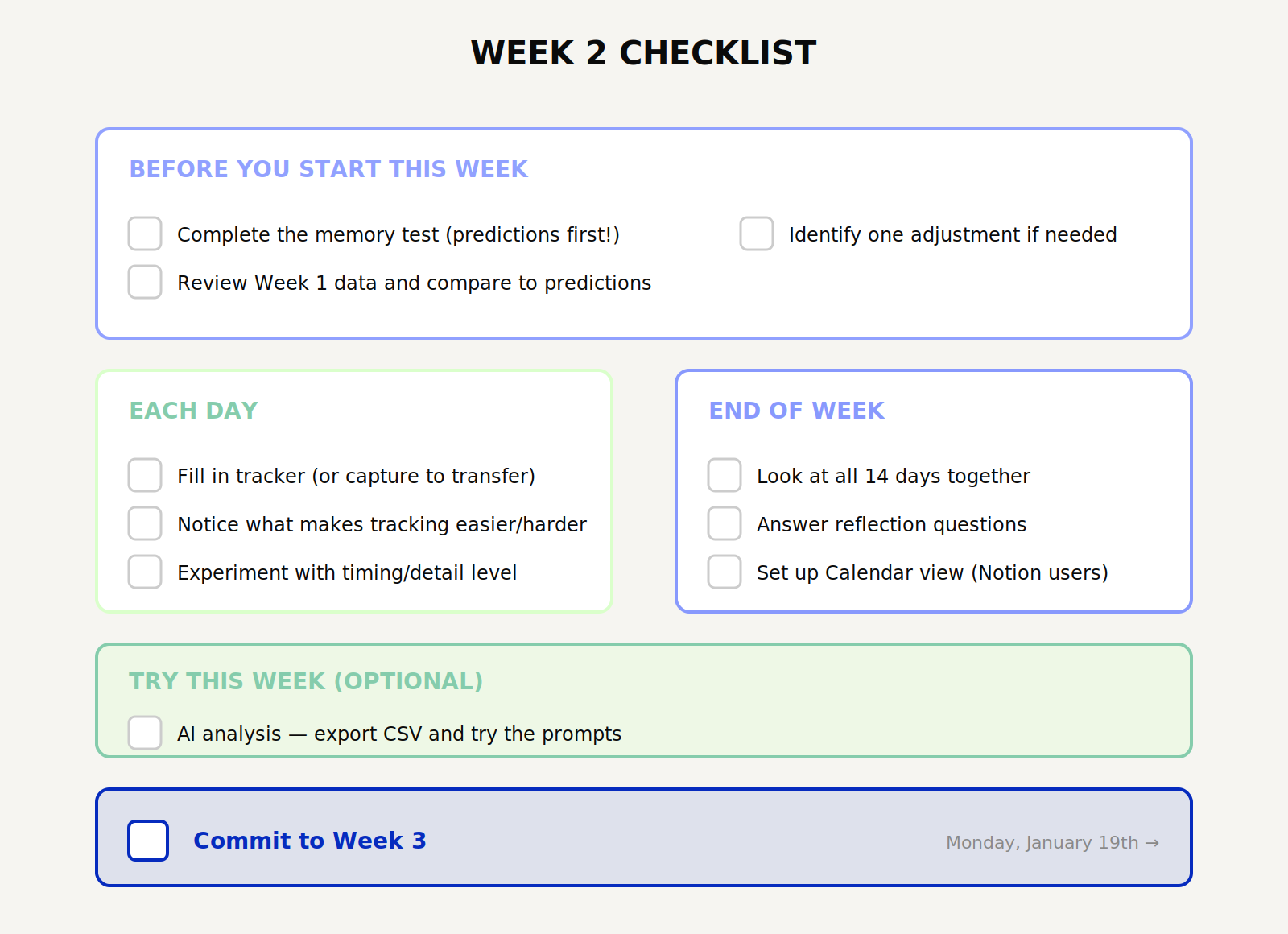
Week 2 checklist
The memory test — memory vs reality (your first real insight)
Making tracking sustainable — finding your rhythm, not fighting it
Troubleshooting Week 1 — common issues and fixes
What 14 days reveals — early patterns worth noticing
New view unlocked — Calendar view
Using your tracker as a laboratory
AI prompts to try — discovering your own data stories
Introduction to charts — what they show, when to use them
Daily guidance + end of week reflection


Before you look at your data: the memory test.
I want you to do something before you scroll through your Week 1 tracker. Without looking, write down what you think happened last week:
How many days did you work out?
How many days did you hit your protein goal (or whatever your main metric is)?
What was your average mood or energy?
How many days did you create something vs just consume?
Did you do the thing you said you’d do every day?
Write it down with actual numbers, then go look at your data. How close were you?
This is the whole point. Your memory of your week is probably wrong, not because you’re lying to yourself (though sometimes we do that too), but because memory is reconstructive. You remember the highlights and the lowlights while forgetting the boring middle, and you round in your favor without meaning to. But the data doesn’t do that. The data just shows what happened.
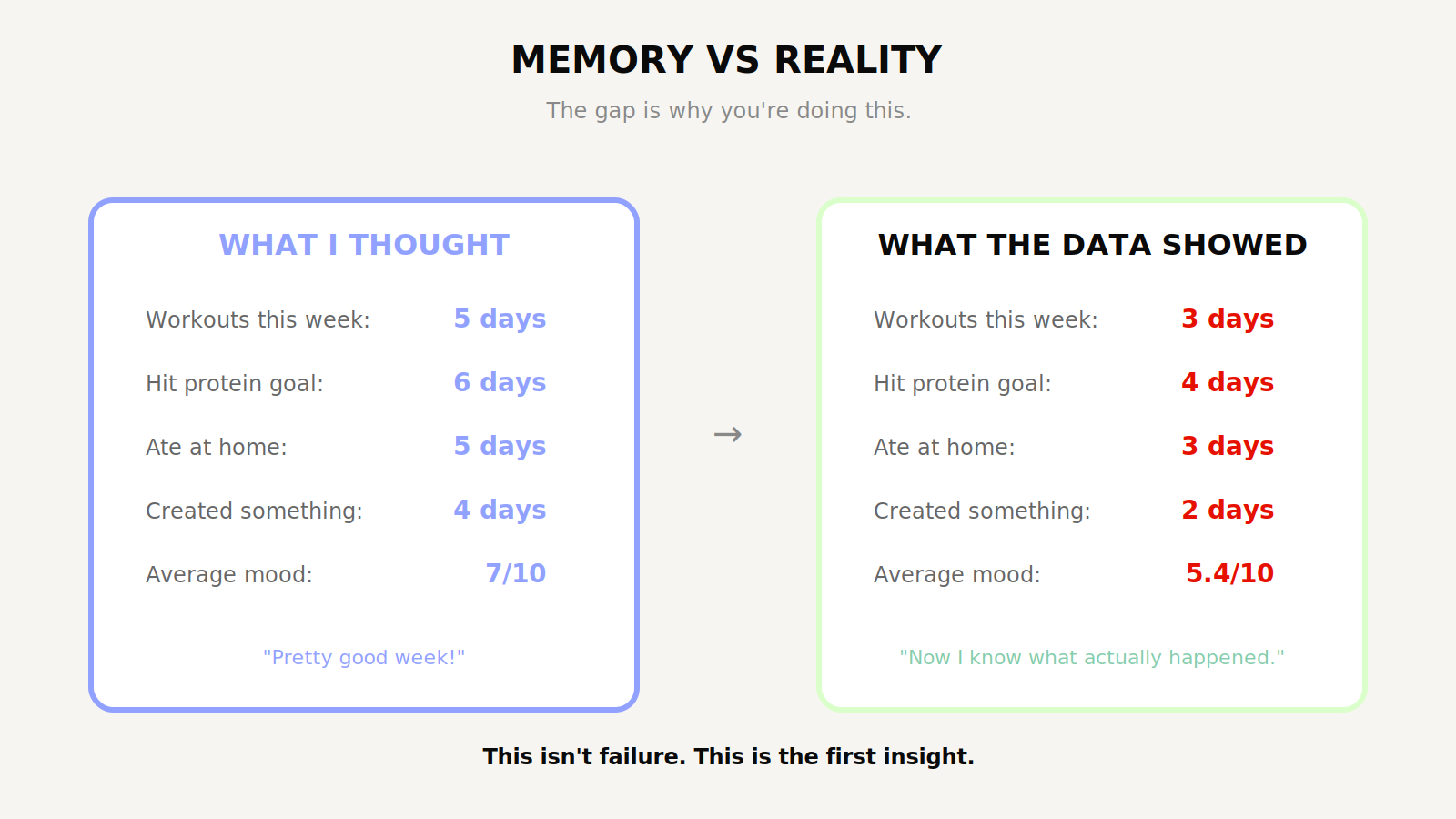
If your memory matched your data perfectly, congratulations—you have unusual self-awareness. But for most people, the gap is jarring. You thought you worked out 5 times; you actually went 3. You thought you were “pretty good” about eating at home; you ate out 4 of 7 days.
This isn't failure, this is the first insight. You now know something true about yourself that you didn't know before, or that you knew but were avoiding.
The gap between what you think you did and what you actually did is exactly why tracking matters.
Here’s an example of something I would have guessed about why my skin was suddenly breaking out vs what my data actually proved instead. I thought sugar caused me to breakout, but it turns out, my chin breakouts correlate exactly to my cycle. I never knew this before this past week!
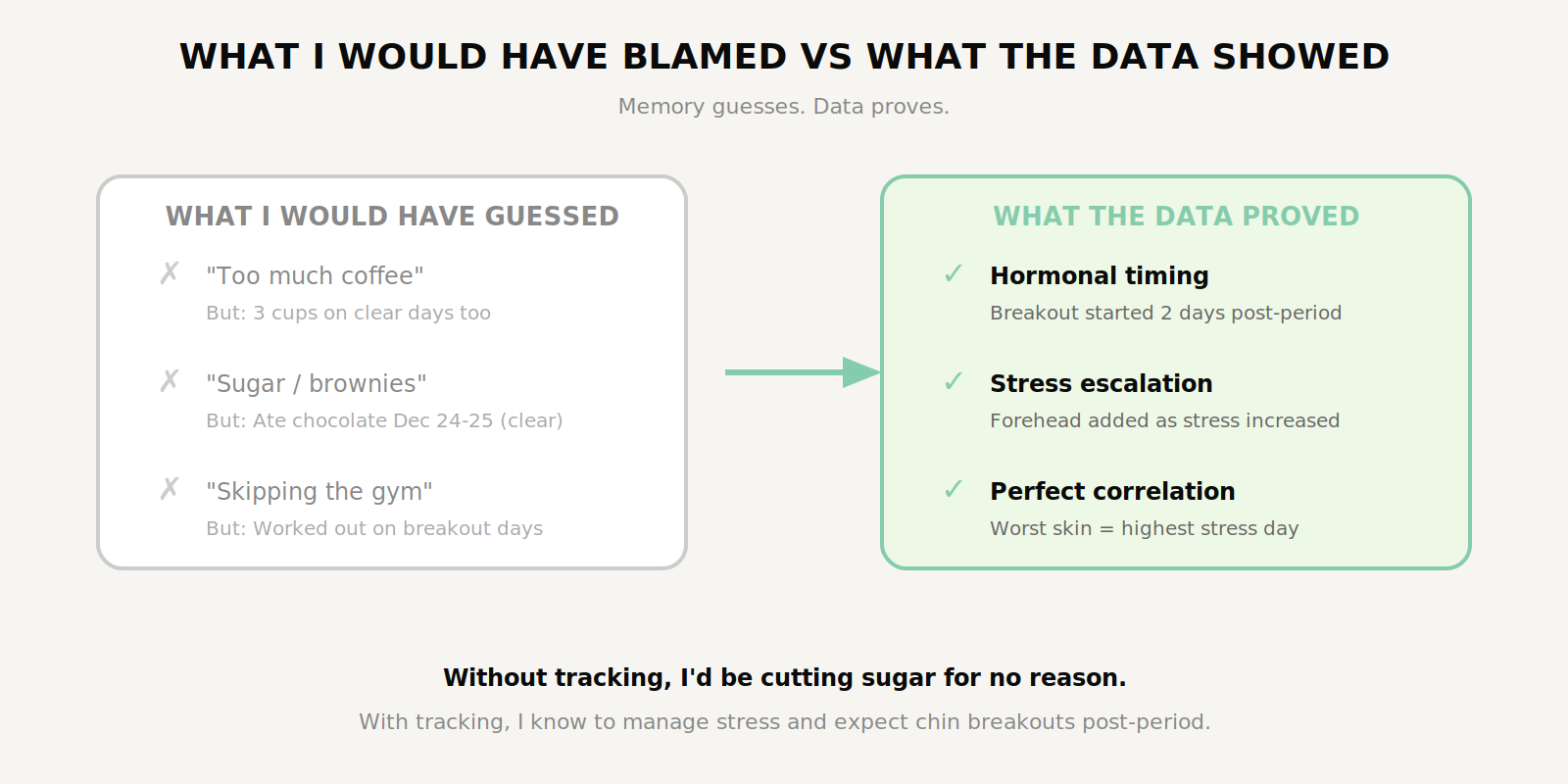
Because of this new information, I was able to adjust my skincare routine (which I also added to my tracker, of course). I’ll share all of that in a later week because I don’t want to risk overwhelming you with data this early. But at a high level, this is how tracking continues to improve my life—by helping me see my patterns more clearly so I can actually interrupt feedback loops to make real, lasting changes.
