


Before you build your tracker, you need to know what goes in it. In order to get the most out of Conscious Creation, the goal isn’t to copy someone else’s template, it’s getting clear on what YOU actually care about, then translating that into things you can measure.
Just 15 minutes with the prompts below will save you weeks of tracking the wrong stuff.
START WITH YOUR GOALS, NOT YOUR HABITS
Most people start by listing habits they think they “should” track: water intake, steps, sleep, screen time. Then they wonder why they don’t care enough to keep tracking.
Flip it. Start with what you actually want, then figure out what behaviors would get you there.
PROMPT 1: What do I say matters to me?
Write down 3-5 things you’d say you value. Don’t overthink it. Examples:
My health
My creative work
My relationships
My financial stability
My mental peace
My career growth
These are your domains. Everything you track should connect to one of these.
PROMPT 2: What would I be doing daily if I were the person I want to become?
For each domain you listed, ask: what does the “future me” version of this look like in daily behavior?
If you say health matters, what does the healthy version of you DO every day? Lift weights? Eat enough protein? Walk? Sleep 7+ hours?
If you say creative work matters, what does the prolific creator version of you DO? Write for an hour? Publish weekly? Avoid distractions?
Get specific. Not “be healthier” but “go to the gym X days/week” and “eat 75g+ protein/day.”
PROMPT 3: What do I suspect is helping me—or hurting me—but I’m not sure?
This is where tracking gets interesting. You probably have hunches:
“I think I’m more productive when I sleep well, but I’m not sure.”
“I think my mood tanks when I scroll too much, but I’ve never measured it.”
“I think I’m more creative after exercise, but maybe that’s just a story I tell myself.”
Write down the hunches that are related to your domains. These become things to track so you can find out what’s actually true.
PROMPT 4: What do I keep saying I’ll “get better at” but never actually measure?
We all have these. The things we vaguely intend to improve but never make concrete. “I should read more.” “I should call my parents more.” “I should spend less money on dumb stuff.”
If you’ve been saying it for months (or years), maybe it’s time to actually track it.
NOW TRANSLATE GOALS → TRACKABLE BEHAVIORS
Take everything you wrote down and turn it into something you can answer in under 5 seconds. Yes/no or a number.
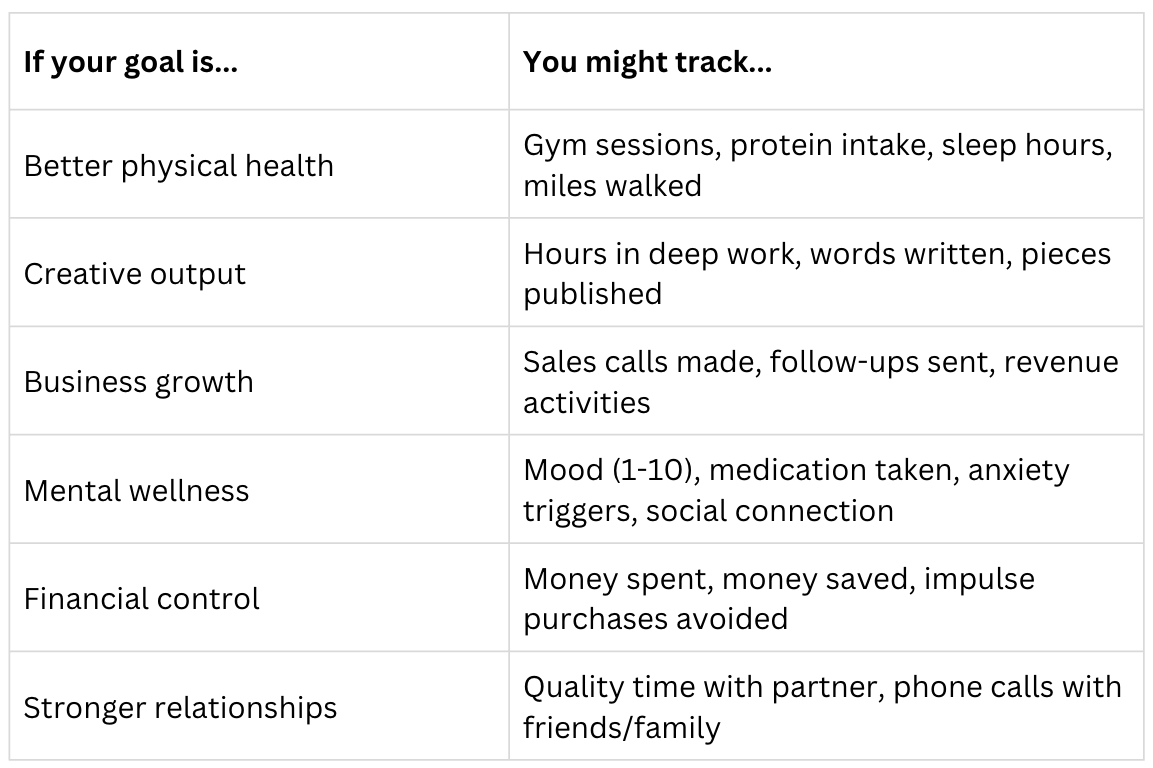
AIM FOR 5-10 THINGS. NOT MORE.
You can always add later, but starting with too many kills the habit before it starts. Pick the ones that connect to your top 2-3 goals and ignore the rest for now.
DON’T FORGET SUBTRACTION
Most people think about tracking in terms of addition: things they want to START doing. Gym. Journaling. Meditation. More water.
But some of the most powerful changes come from subtraction—things you want to STOP doing or do LESS of.
And subtraction is often easier than addition because you don’t have to find extra time or energy. You just... don’t do the thing.
Subtractions you might track:
Didn’t drink alcohol (Y/N)
Didn’t smoke (Y/N)
Didn’t eat after 8pm (Y/N)
No social media before noon (Y/N)
No impulse purchases (Y/N)
Didn’t hit snooze (Y/N)
No caffeine after 2pm (Y/N)
Didn’t complain (Y/N)
Didn’t break a promise to myself (Y/N)
Why this matters:
Adding a gym habit requires time, energy, equipment, motivation. Quitting alcohol requires... not doing something. The effort is different. For a lot of people, subtraction is where the real leverage is—especially early on.
Ask yourself:
What would change if I just STOPPED doing something I know isn’t serving me?
That’s trackable too.
A NOTE ON “STREAK MENTALITY”
Tracking subtraction can create powerful streaks. “14 days no alcohol” hits different than “went to the gym 6 times this month.”
But streaks can also backfire. One slip and people think “streak’s broken, might as well give up.”
If you’re tracking subtraction, focus on percentage over time, not perfect streaks. 85% alcohol-free days in a quarter is a massive win, even if you weren’t “perfect.”
WHAT ELSE COULD YOU TRACK?
Most of my examples lean toward health and daily routines because that’s what I’m focused on right now, but tracking works for almost anything where patterns matter and memory lies.
Professional:
Client calls made / pitches sent (are you actually doing the outreach you think you are?)
Hours of deep work vs. meetings vs. reactive tasks
Days you hit inbox zero
Projects completed vs. started
Creative:
Words written / hours practiced / pieces finished
Days you created vs. consumed
Submissions sent (queries, applications, pitches)
Ideas captured
Relationships:
Days you called/texted a specific person
Quality time with partner (not just “were we in the same room”)
Dates or intentional 1:1 time
Acts of service / things you did for someone else
Financial:
No-spend days
Impulse purchases (Y/N or $)
Days you checked your budget
Savings deposits made
Mental health:
Mood (1-10)
Anxiety level (1-10)
Panic attacks or notable episodes
Therapy sessions / meditation / journaling
Medical:
Symptoms
Medications taken
Pain levels
Cycle tracking
Doctor’s appointments and what was discussed
The point isn’t to track all of this at once. The point is that whatever you care about improving or understanding, you can probably track it—and the data will show you things your memory never would.
STILL STUCK? USE AI TO HELP.
Copy your answers from the prompts above and paste them into Claude or ChatGPT with this:
“Based on what I wrote about my goals and values, suggest 5-10 specific things I could track daily. Keep them simple—yes/no or numbers only. Explain why each one connects to what I said matters to me.”
The AI will help you translate your fuzzy goals into concrete trackable behaviors.
