


What's in this post:
Who I am, and why I built Conscious Creation
What the program actually is
How the tracking works
Examples of data stories from my personal tracker
What you'll get when you join
Who Conscious Creation is for (and who it isn't)
Updated January 5 → WEEK 1 IS NOW LIVE
Get started today for 20% off.

Most people have no idea how they actually spend their time.
They think they’re consistent, they think they’re making progress, they say they value health, creativity, relationships, and they genuinely believe their behavior reflects that. But if you asked them to prove it, they couldn’t. They’re operating on vibes and memory, and memory is a liar that works for your ego.
I know because I was that person. And I stayed that person until I started tracking my behaviors.
I spent most of my life believing I knew myself pretty well. I valued discipline, so I thought I was disciplined. I cared about creativity, so I assumed I was creating consistently. I said relationships mattered, so surely I was investing in them properly. The story I told myself about who I was felt true because I wanted it to be true, and wanting something to be true is a powerful form of self-deception.
But data typically tells a different story than feelings.
A simple spreadsheet is how I lost 35 pounds. Tracking my triggers and physiological responses is how I quit weed. Writing down what I actually did every day—not what I meant to do or what I remembered doing—is how I finally closed the gap between who I thought I was and who I actually was. That gap between my self-image and my actual behavior became impossible to ignore.
Tracking is boring and incredibly unsexy, which is likely why nobody really posts about it. But it’s the thing that made every hard choice I’ve made in the last decade possible.
That’s why I built Conscious Creation, and that’s why I’m so excited to share it with you.
But before I tell you how Conscious Creation works, let me answer a question I’ve never addressed directly:
Who the f*ck am I to ask you to do any of this?
I often ask people to do hard things.
Quit the habit. Walk away from the money. Choose discomfort over stagnation. Sit with the thing you’ve been avoiding. Build systems instead of waiting for motivation. Stop lying to yourself about what you actually want.
I’ve been writing essays like this for almost 2 years now, and I’ve never once stopped to explain why I think I get to say any of it. Who am I to tell you to choose better? Who am I to ask you to do things that hurt or feel uncomfortable?
So, allow me a moment to introduce myself properly.

In 2015, I left the small California beach town where I’d spent my entire life.
I moved to Las Vegas where I knew no one. I had no friends, no network, no safety net, just a retail job I hated and a rented room in a stranger’s house. I was an introvert relocating to a city built for extroverts, starting from zero in every possible way.
It was the most terrifying thing I’d ever done.
I’m not going to romanticize it, there was no “finding myself” montage. It was lonely and disorienting and I questioned the decision constantly, but I also knew that staying where I was comfortable meant staying who I was, and I wanted to become someone else.
So I sucked it up on my own and embraced the unfamiliar. Eventually a rented room became a rented house with a roommate. The roommate situation eventually became my own place. Retail job became career became entrepreneurship. The life I have now—the one where I live in the desert mountains with my dogs and write for a living—exists because I got in my car a decade ago and drove toward something that scared the living shit out of me.
My entire life is different because I made that one choice in my mid-twenties.

After the novelty of Vegas wore off, I decided to quit drinking in 2020.
Not because I had a rock-bottom story or a dramatic intervention. I quit because I was tired of the brain fog, tired of “recovering” from the night before, or operating at 70% capacity and wondering why I couldn’t think clearly, couldn’t write well, couldn’t access the version of myself that I knew was in there somewhere.
The downstream effects had become impossible to ignore. Poor sleep, low energy, muddled thinking, a constant, low-grade haze between me and my own potential. I wasn’t an alcoholic by any clinical definition, but I was someone who couldn’t become who she wanted to be while maintaining the habit. So I stopped.
On January 1, 2025, I quit weed for the same reasons. Different substance, same calculation. I’d been using it to wind down, relax, “take the edge off,” or whatever other story I was telling myself to justify continuing using it—and it was costing me clarity. Costing me mornings, costing me the sharp, fully-present version of my mind that I need to do the work I want to do.
I didn’t go to rehab or join a program. I used willpower and the same boring systems I write about on this site. I tracked my triggers, built replacement habits, and white-knuckled through the discomfort until it became my new normal.
It wasn’t easy by any means, but I wanted my mind back more than I wanted the comfort of staying numb to the things I didn’t want to face or feel.

Sobriety ended up teaching me a lot about myself and what I actually valued.
In 2021, I walked away from my six-figure Instagram account.
I’ve written about this before, but the short version is that I’d built something that looked like success but felt like slow spiritual death. I was making tens of thousands a month posting brand partnerships, and I was absolutely miserable. The performance had colonized my entire life. Nothing was mine anymore. Everything was content.
So I deleted it. Not “took a break” or “pivoted my strategy.” Deleted. Disabled the account, bailed on upcoming partnerships, walked away from the money and the momentum and the trajectory that everyone around me said I’d be insane to abandon.
It wasn’t brave in any capacity. It was necessary. The gap between who I was performing and who I actually was had become unbearable, and I value authenticity more than I value comfort. So I ditched it.

Around this same time, I also walked away from a corporate job that was paying me very well to be treated very poorly.
I’m not going to name the company or the CEO because that’s not the point, and I’m not interested in public drama, but I will say this: when I resigned, I was offered a substantial sum of money to sign an NDA. The kind of money that makes most people shut up and move on.
I told him, in more colorful language, where he could put it.
Not because I planned to go scorched earth—I didn’t, and I haven’t—but because I’m not the person who gets bought into silence. If the only way to keep me quiet is to pay me off, then you already know what that says about what happened. I’d rather walk away broke and intact than comfortable and complicit.
I don’t say this to sound noble, I say it because it cost me. It was a hard choice. But I made it anyway because the alternative was becoming someone I didn’t respect.

2021 was a busy year for me. The downstream effects of sobriety and finding my authentic voice and inner clarity were pouring over into every aspect of my life.
I lost 35 pounds this year.
I’d been feeling terrible for months, if not years—constant fatigue, nausea, joint pain, a general sense that my body was working against me instead of for me. So I opened an Excel spreadsheet, started tracking what I ate, and committed to a painfully boring routine: eat less, walk more, lift weights a couple times a week.
That’s it. No special diet, no expensive program, no biohacking protocol or optimization stack. Just a spreadsheet and consistency.
I hit my goal weight in less than six months.
Furthermore, after losing the weight, I was able to stop taking all NINE of the prescription medications I’d been on—some for almost a decade! I had been taking everything from anxiety meds, to anti-nausea pills, to pain killers for the joint pain. Not to mention, I was early in the process of being tested for rheumatoid arthritis, which is a whole other story, but the point is: all these ailments “miraculously” disappeared when I took control of my health and intentionally changed course.
I’m telling you this not because I think weight loss is the measure of anything important, but because it’s a clean example of what I actually believe: simple systems, applied consistently, produce results. The unsexy truth is that this is what change actually looks like. Not transformation porn or before-and-after theatrics. Just a spreadsheet and the willingness to do the boring thing every single day.

Enter 2026, and I still live this way.
I wear my Oura ring, I track my meals, I have routines that would put most people to sleep just hearing about them, but those routines are the scaffolding that keeps my life stable enough for me to do the work I actually care about.
I’m not sharing this to impress you, nor do I think any of this makes me special. Plenty of people have walked away from more, quit harder things, lost more weight, built better systems, or moved to a new state.
I’m sharing it because I ask people to pay me for what I write. I offer frameworks and guidance and calls to intentionality, and if you’re going to spend money on that, you deserve to know that I’ve pressure-tested this stuff on myself first, over the course of many years. I’m not dispensing advice from some theoretical perch. When I say “choose the hard thing,” I’ve chosen it—repeatedly, at real cost, with real consequences.
I know how hard it is to leave everything familiar and start over. I've left it.
I know how hard it is to leave the money on the table. I’ve done it.
I know how hard it is to quit the thing that’s numbing you. I’ve quit it.
I know how hard it is to build uncomfortable systems when you’d rather just wing it. I’ve built them.
I know how hard it is to choose discomfort when comfort is right there, available, easy. I’ve chosen it anyway.
I’m not a “do as I say, not as I do” person. That’s the whole point. Everything I share here—every framework, every essay, every call to build a more intentional life—comes from someone who’s living it. Imperfectly, but actually.
I don’t ask you to do anything I haven’t done myself. And when I ask you to do hard things, I’m not asking from a lectern, I’m asking from the other side. I know how good it feels to write your own story, and if I can help even one person start writing theirs, I have done my job.
Radical self-responsibility is terrifying. It’s also the only way to become truly free.

Don’t just take it from me. Here’s what readers had to say.
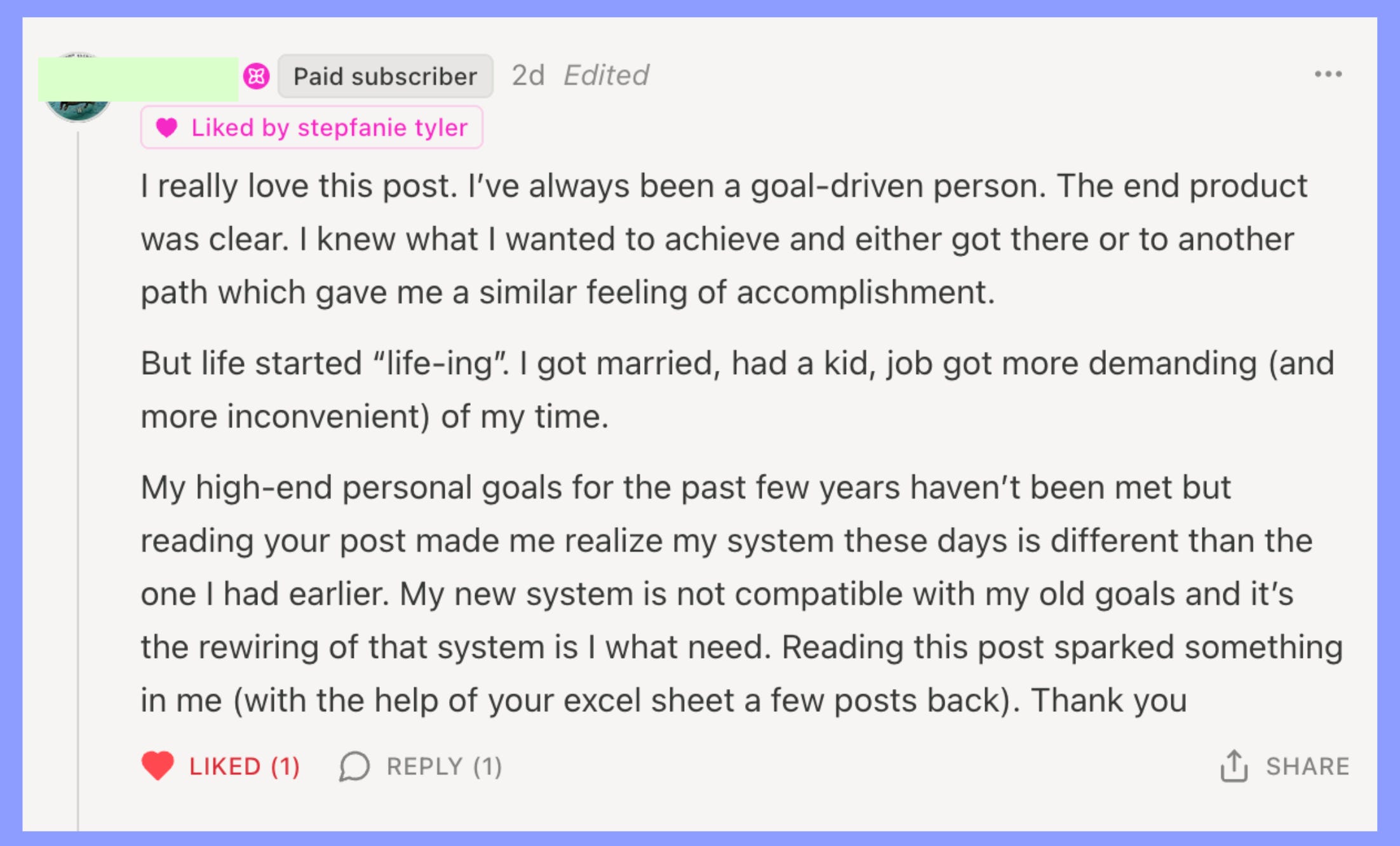
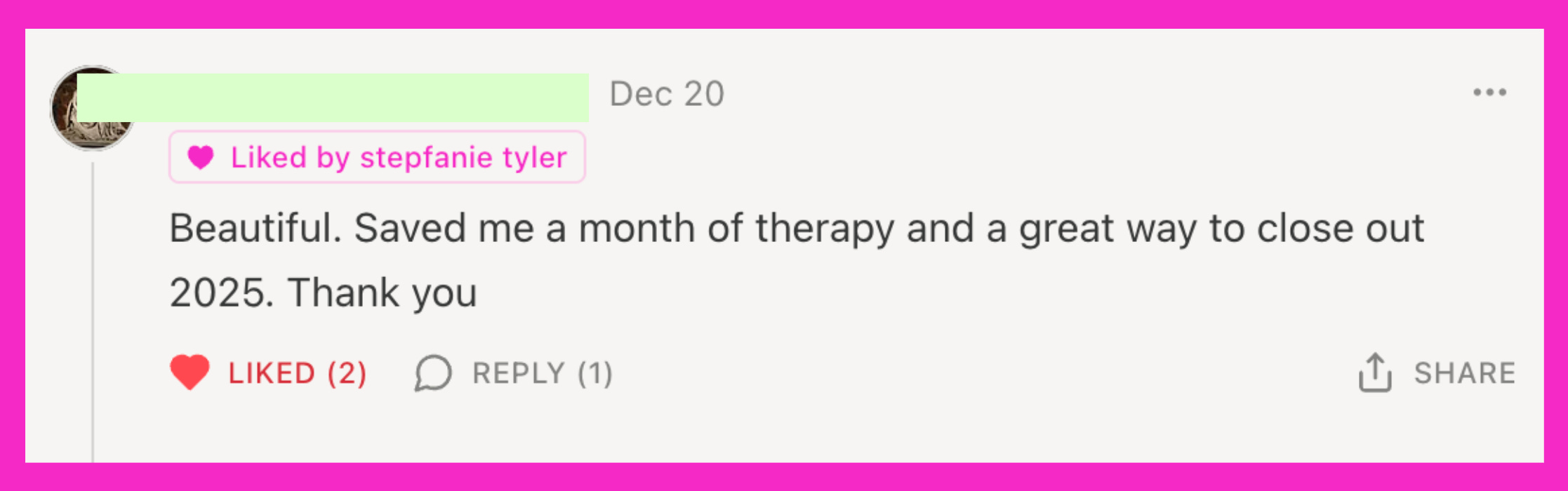
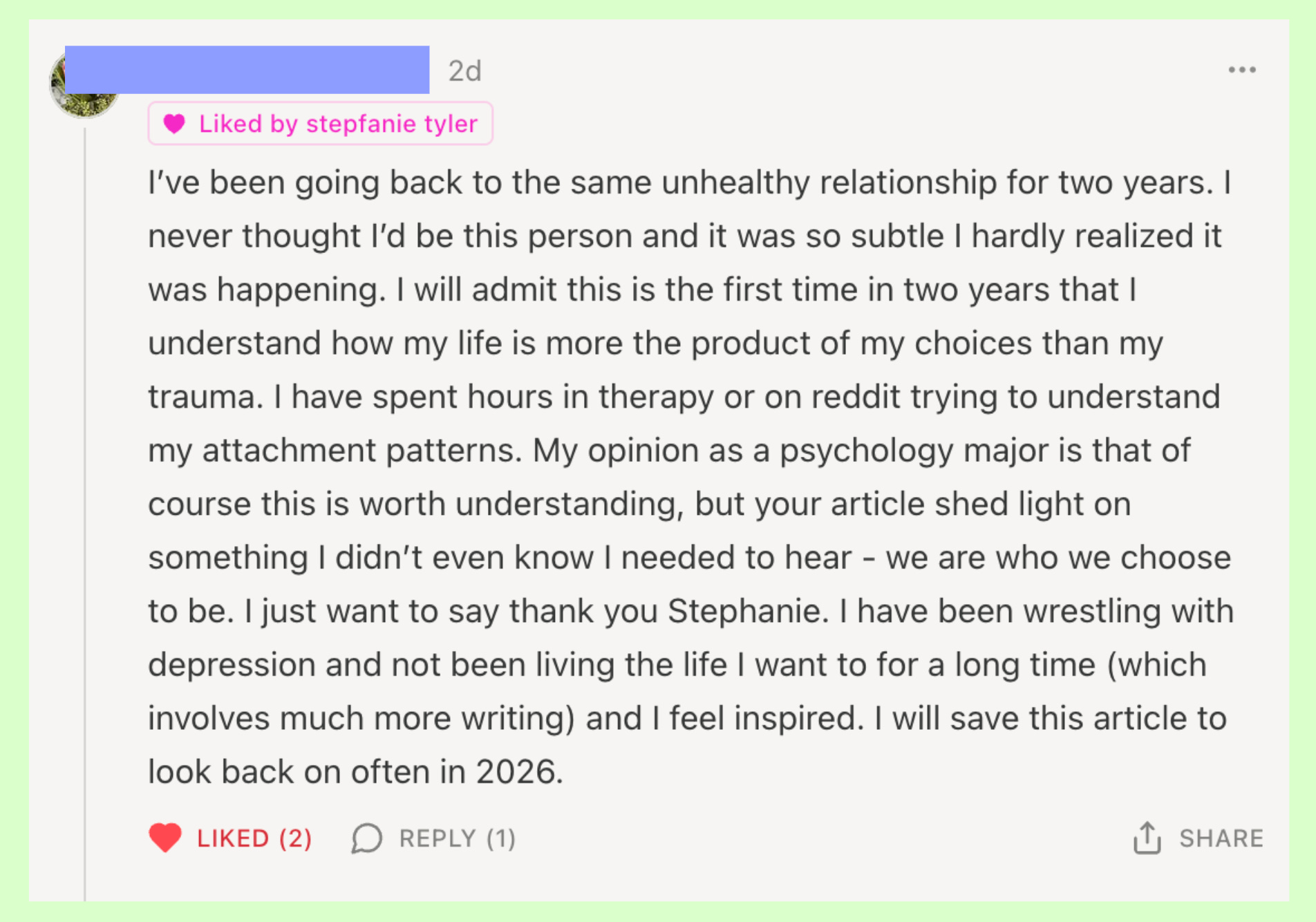
These are the shifts that happen when someone stops blaming circumstances and starts seeing their life as constructed.
Constructed by choices. Built by patterns. Shaped by what they do every single day—not what happened to them, not what they meant to do, but what they actually chose.
That realization is powerful, but it’s also fleeting.
Most people have that moment of clarity, feel inspired for a week, then drift back to their default patterns. Not because the insight wasn’t real, but because insight without evidence fades.
Conscious Creation is what comes after the realization.
It’s twelve weeks of guided tracking that turns “I’m in charge of my life” into proof. 84 days of data showing exactly what you’re choosing, what’s working, what’s not, and how your behavior across different domains creates the life you’re living.
By March 31st, you won’t just feel like you have power, you’ll have evidence showing exactly how you’ve been using it—and how to use it better.
Data is just truth, uncomfortable or not.
This is why I built Conscious Creation.
Not because tracking is virtuous or because data is inherently meaningful, but because most people stay stuck in the same patterns for years without realizing the patterns exist. They try harder with willpower, they set “better” goals, they read more self-help books, and nothing fundamentally changes because they’re treating symptoms instead of seeing the system. You can’t fix a system you can’t see, and you can’t see a system when you’re living inside it without any way to step back and look at the structure.
Twelve weeks of tracking gives you that vantage point. It shows you the feedback loops—positive and negative—that are running your life automatically. It shows you what actually predicts what, which keystone habits create cascading improvements across multiple domains, and which failure points create cascading breakdowns. It shows you whether you’re actually moving toward what you say you want or just drifting while telling yourself you’re making progress.
Want to track with a friend or family member?


Before you track anything, you have to get clear on what you’re actually trying to build. This is where most tracking systems fail. They hand you a generic template and hope it fits. Conscious Creation starts with YOUR life.
Not sure what to track? Start here.
Ask yourself:
What do I say matters to me? (health, creativity, relationships, wealth, peace)
What would I be doing daily if I were the person I want to become?
What behaviors do I suspect are helping me—or hurting me—but I’m not sure?
What do I keep saying I’ll “get better at” but never actually measure?
Then translate those into trackable behaviors:
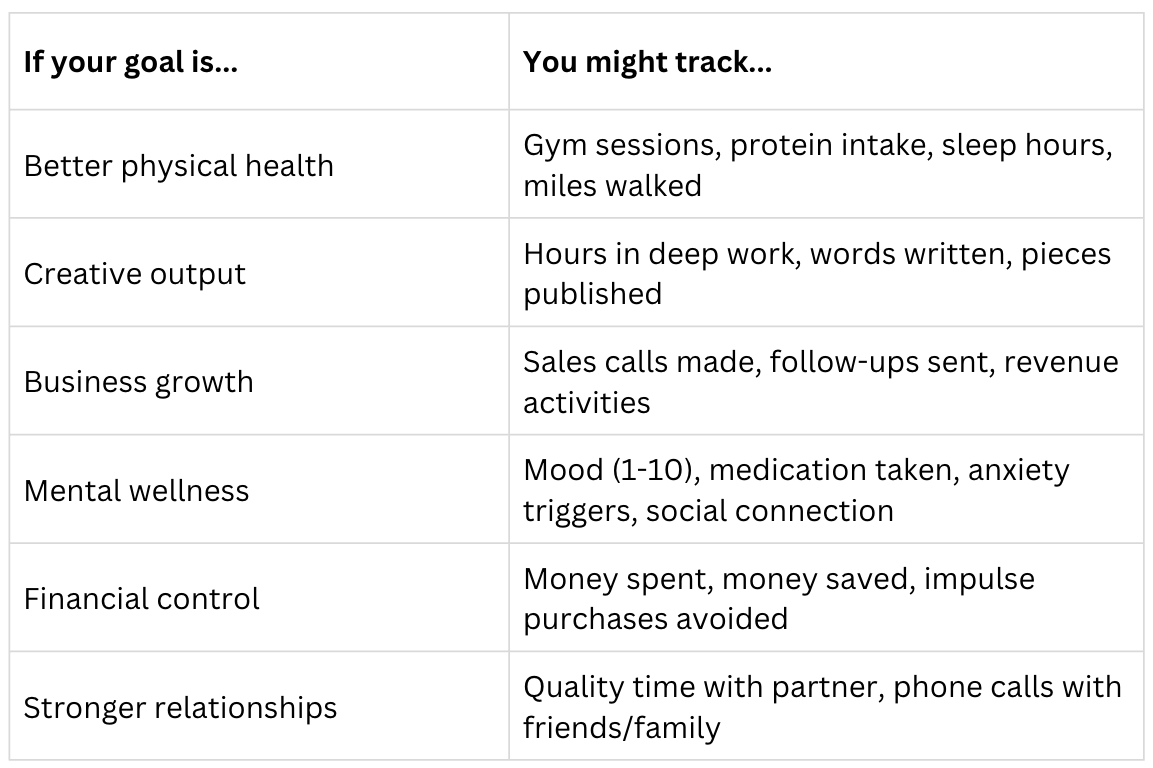
The key is making it binary or numeric whenever possible:
Did I go to the gym? Yes/No
How many grams of protein? [number]
Did I publish something? Yes/No
Mood today? 1-10
If you can’t answer it in under 5 seconds, simplify it.
You don’t need to track everything. Start with 5-10 things that align with your top 2-3 goals. You can always add more later once the habit is solid.


Once your tracker is set up, you're just checking boxes. Yes or no. A few numbers. That's it. You're not reflecting yet, you're just building the habit of noticing your own life and figuring out the most sustainable routine for jotting things down.
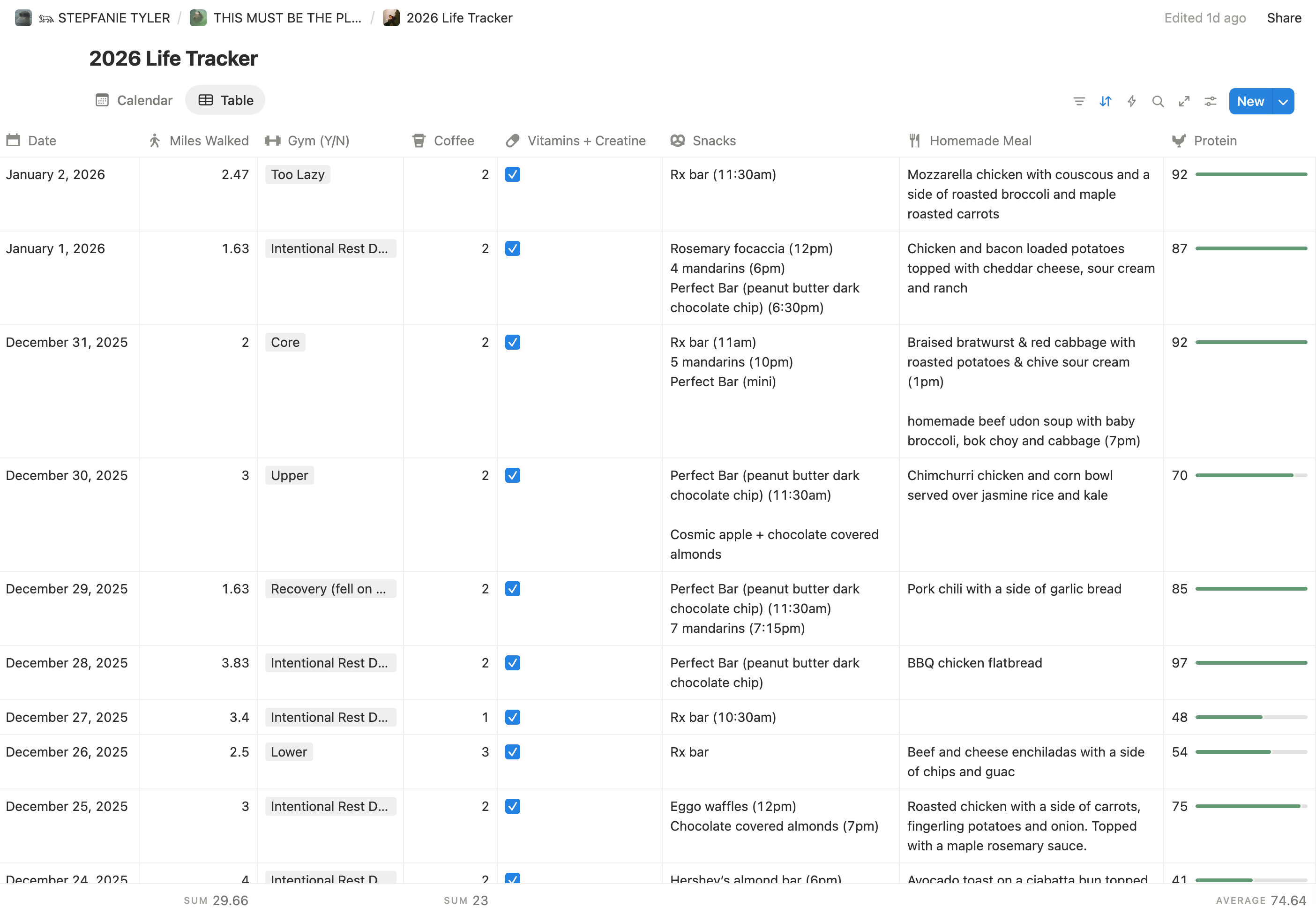
Here’s a screenshot of a portion of my personal tracker. I like to use Notion because it allows for checkboxes and recurring tags. The initial tracker takes a little longer to setup than a spreadsheet, but it’s quicker for day-to-day recording.
You can create your own Notion tracker using this simple template. Once it’s in your Notion workspace, you can tweak it to fit your goals and needs.

After you’ve collected data, you give it to Claude*, ChatGPT, Gemini (whatever LLM you prefer will work) and ask questions:
“What patterns do you see?”
“Show me my consistency.”
“What am I building without realizing it?”
“Create a visualization that shows [specific thing].”
The AI does the analysis. You get the insights. No spreadsheet skills required.
* I personally prefer to use Claude because I think it has the best coding skills, which translates to the best graphs and charts. ChatGPT can translate the data just as well, but the outputs aren’t as “pretty” and customizable as what you can get with Claude.

Here are 6 examples of prompts I used with Claude after uploading my initial 2 weeks of data (“data stories”)
Example 1: Raw Data
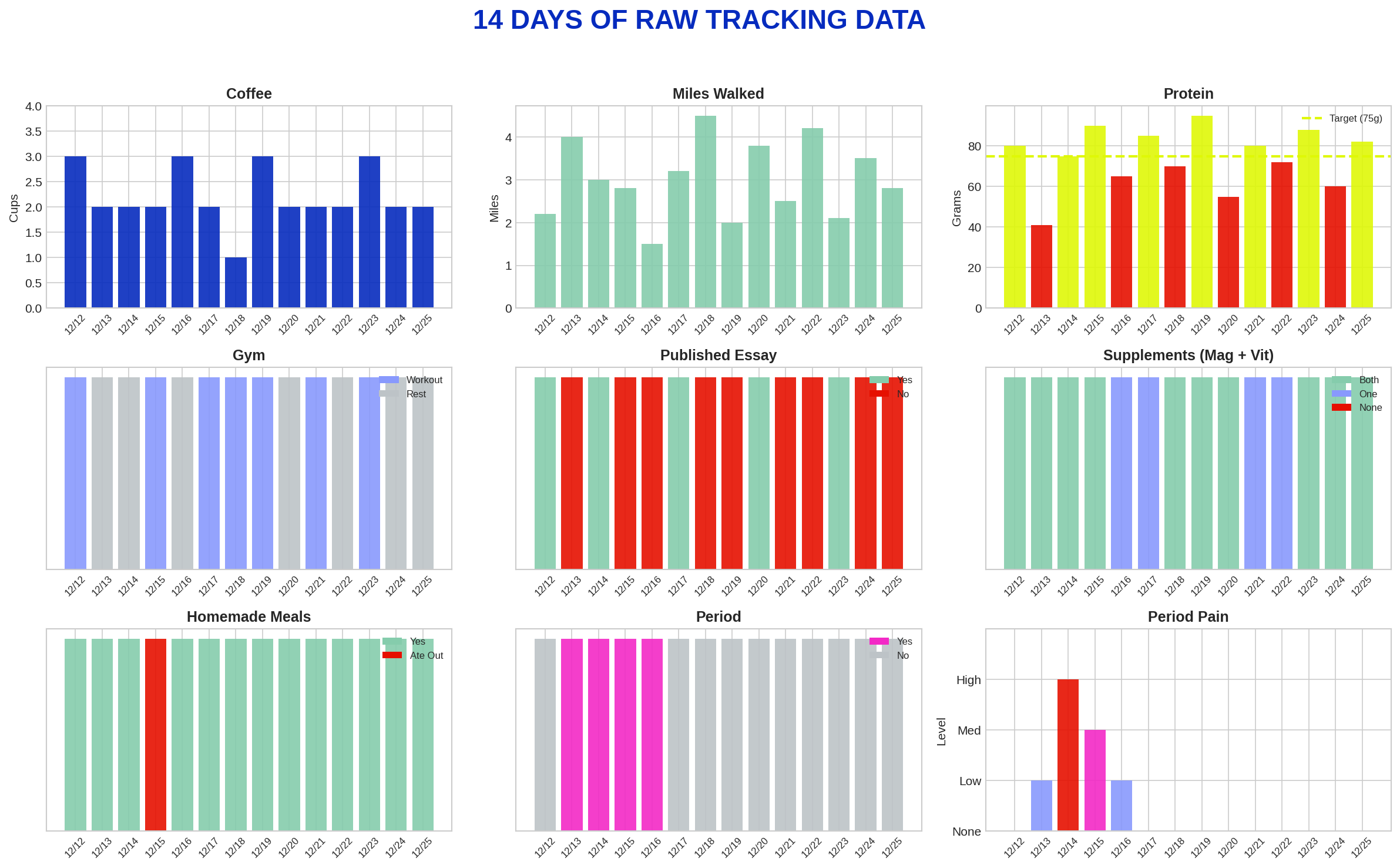
What it is: The raw inputs, visualized. Every checkbox, every number, laid out day by day.
How it got made: I gave Claude two weeks of tracking data and said “show me what I tracked.”
Time to track: 90 seconds/night
Time to create this: One prompt
Your version will likely track different things, but the format stays simple: checkboxes, numbers, 90 seconds. AI handles the rest.
Example 2: Life Dashboard
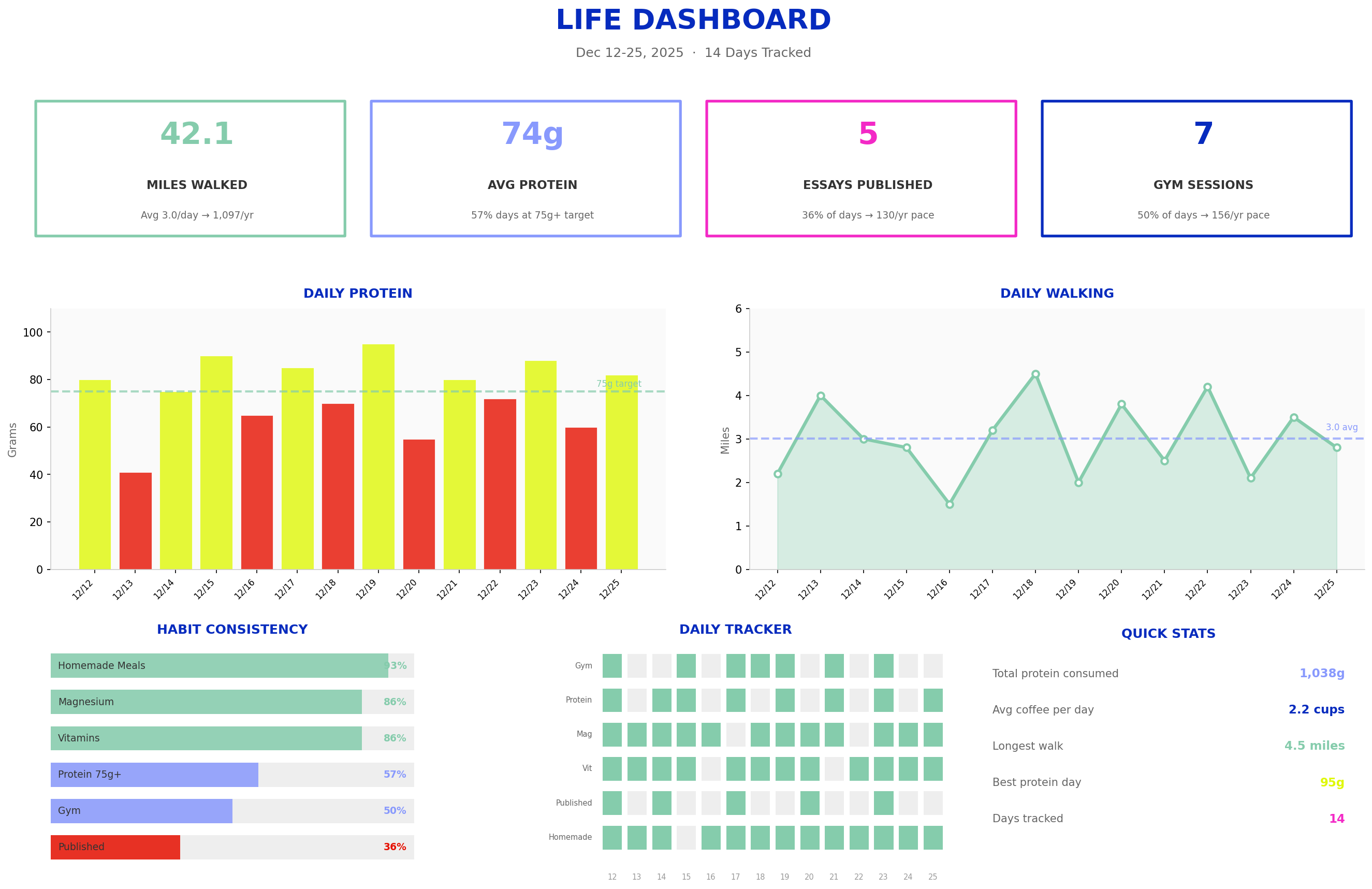
What it is: Everything at once—key metrics up top, trends over time in the middle, habit consistency at the bottom.
How it got made: “Take my data and create an overview dashboard I can update over time.”
What it shows you: You stop seeing individual days and start seeing systems. Where you’re consistent. Where you’re not. How things connect.
The best part: You don’t need to know how to build dashboards, you just ask for one.
Example 3: Walking Data
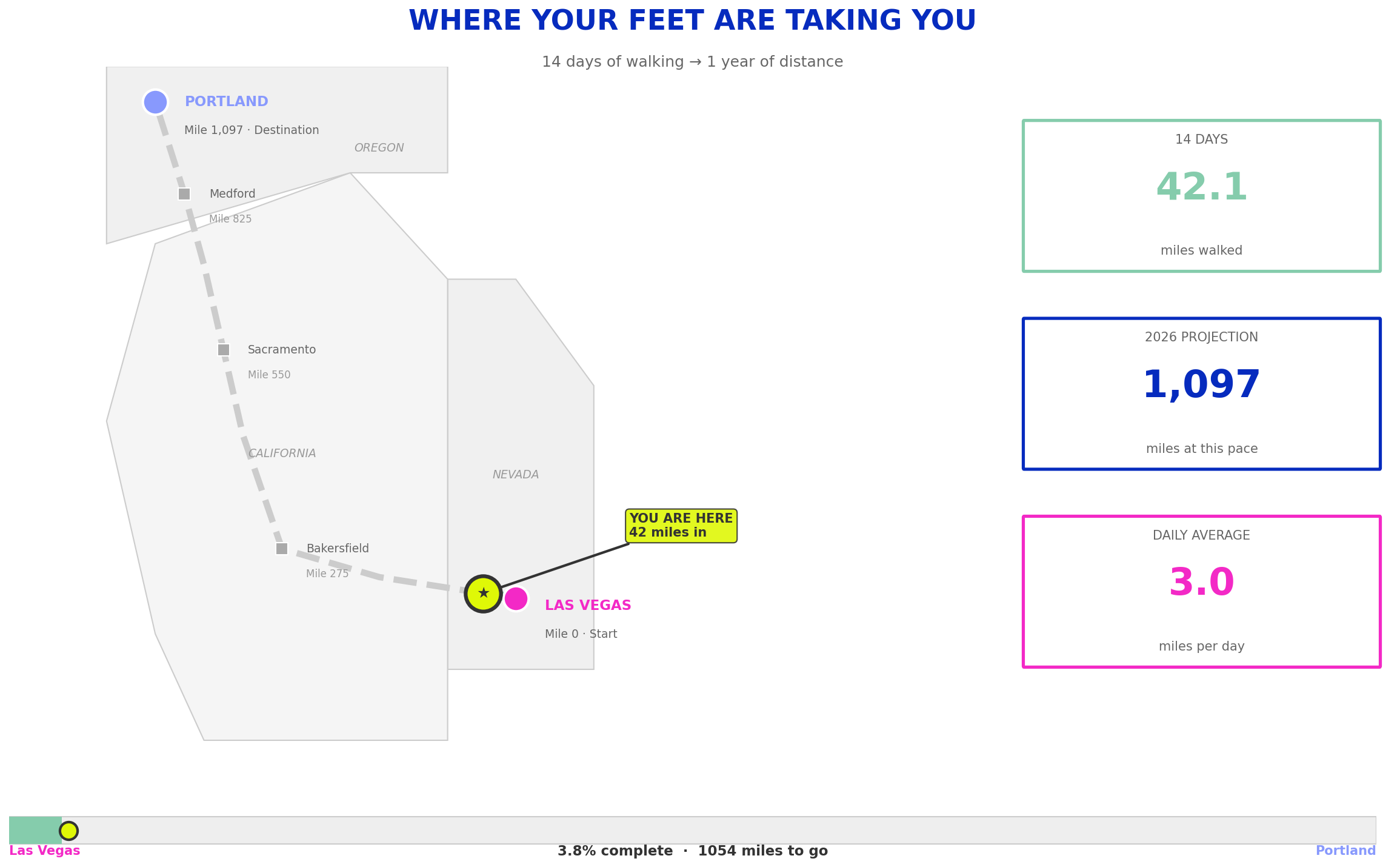
What it is: My walking data turned into a journey. 42 miles in two weeks = 1,097 miles/year = the distance from Las Vegas to Portland.
How it got made: “Show me something interesting about my walking data.”
Why it matters: I’m going to walk to Portland next year. I didn’t know that until Claude showed me.
This is what I mean by data stories. The AI takes something invisible and makes it tangible (and often, fun). What are YOU building without realizing it?
Example 4: Protein Intake Streak
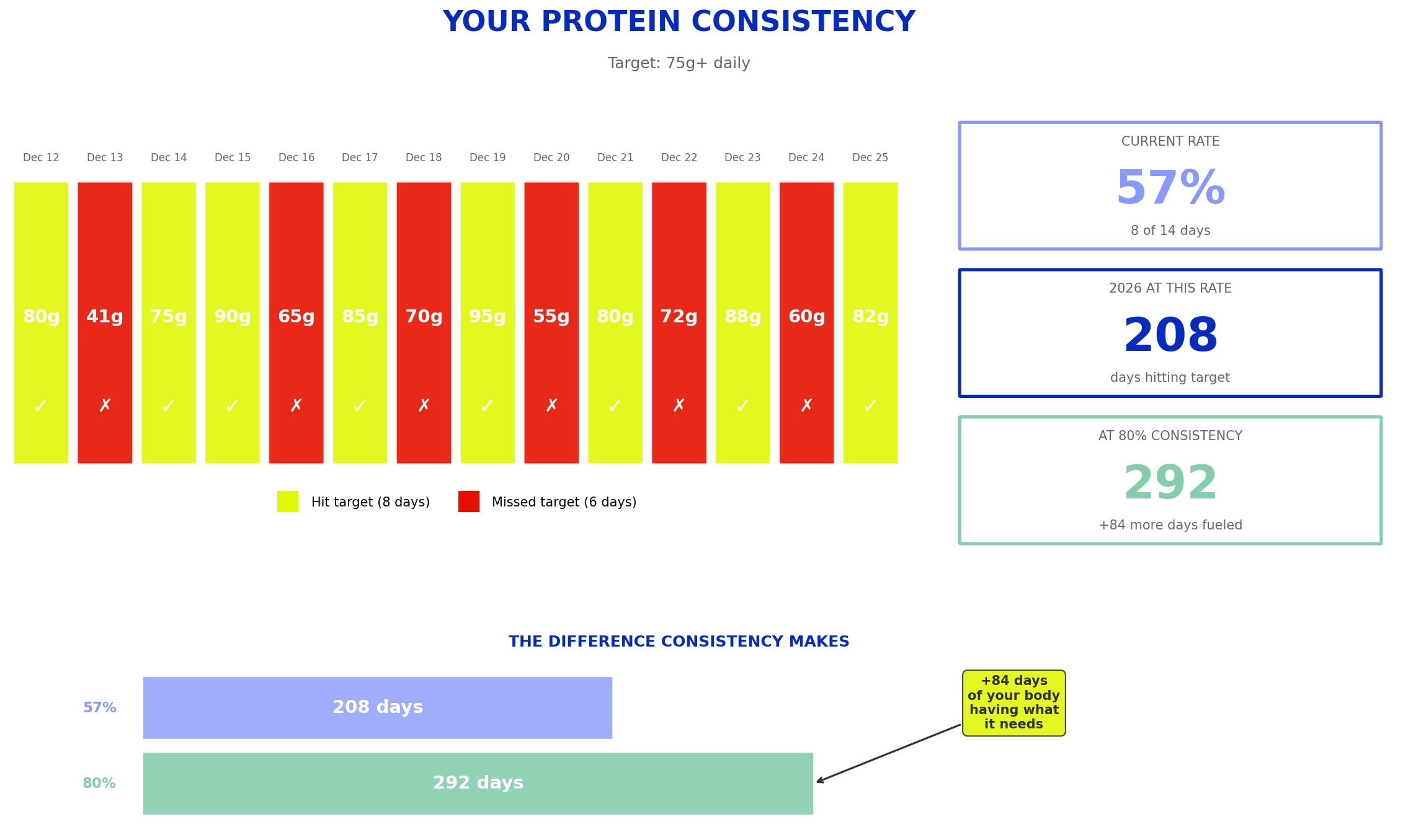
What it is: A streak tracker showing hit vs. miss days, overall consistency percentage, and yearly projection.
How it got made: “Show me my protein consistency as a visual streak.”
What I learned: I hit my target 57% of the time. Getting to 80% = 84 more days per year of my body having what it needs.
Works for any consistency goal—sleep, creative output, screen time, whatever you’re trying to maintain.
Example 5: Overall Consistency
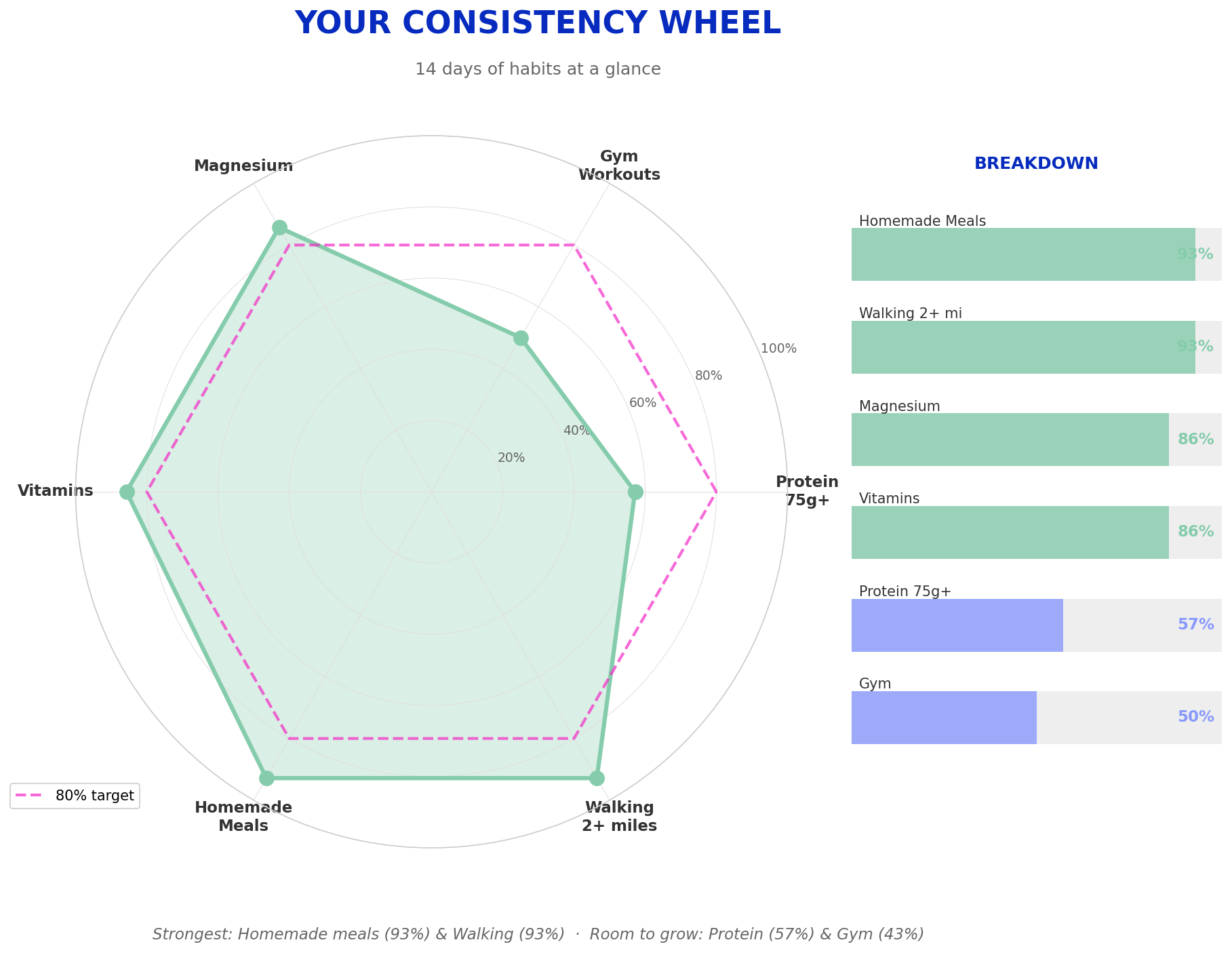
What it is: A radar chart showing all habits at once. Each spoke = one behavior. Further out = more consistent.
How it got made: “Show me all my habits on one chart so I can see where I’m strong and where I’m slipping.”
What I learned: I’m tight on homemade meals (93%) and loose on gym (43%). No judgment, just information about where to focus or refocus.
Example 6: Compounding Data + Future Projections
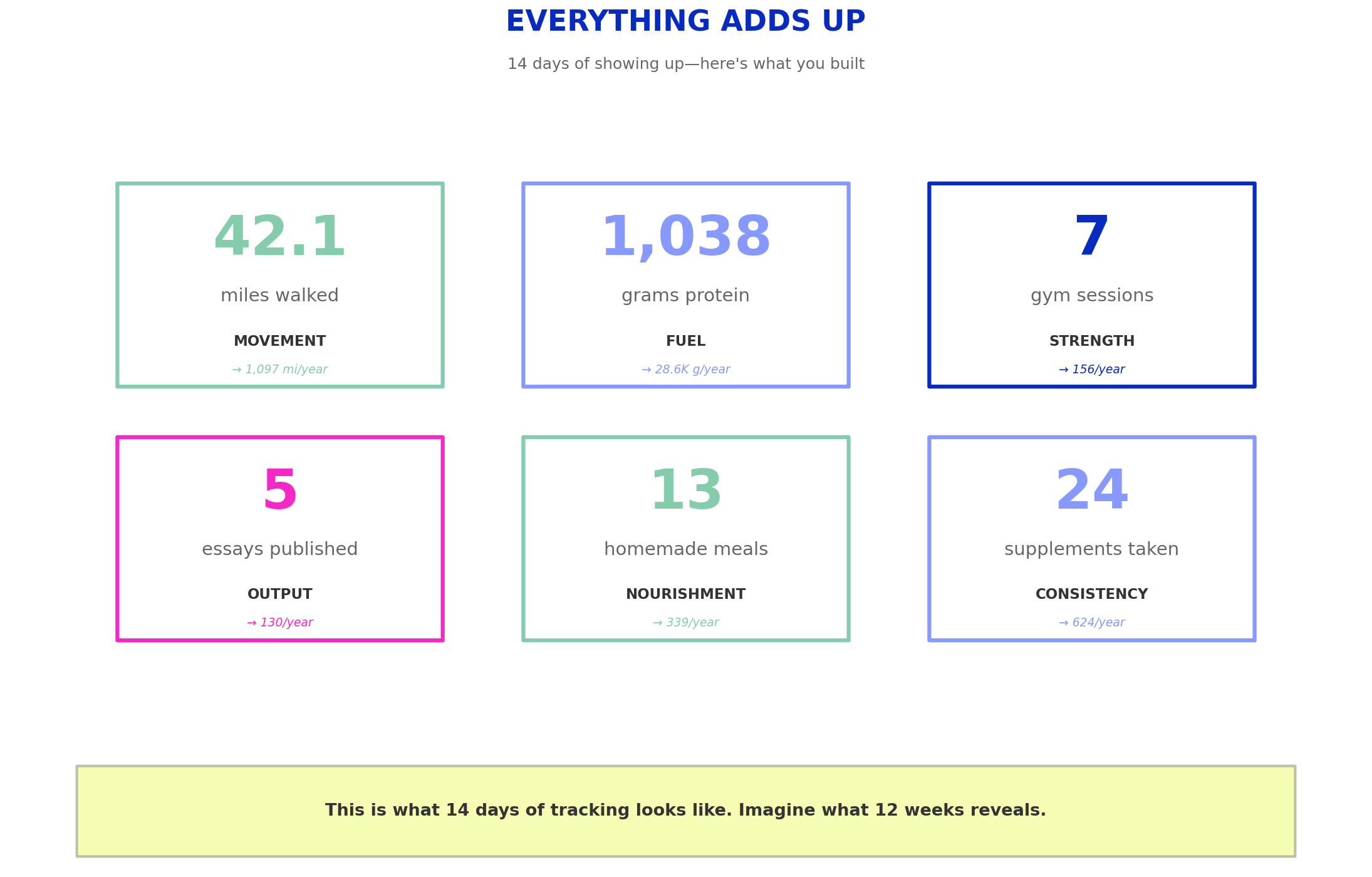
What it is: The cumulative view. Not percentages—just totals. What did 14 days actually produce?
How it got made: “Show me the totals of everything I tracked, with yearly projections.”
What I learned: 42 miles walked, 1,098g protein, 6 gym sessions, 5 essays published. Small daily actions compound faster than you think.
Creating the above visuals took me 14 days of recording data (around 90 seconds per night), and about 10 minutes of back-and-forth with Claude. That's it. It really can be as simple or as detailed as you want.

The nuts and bolts.
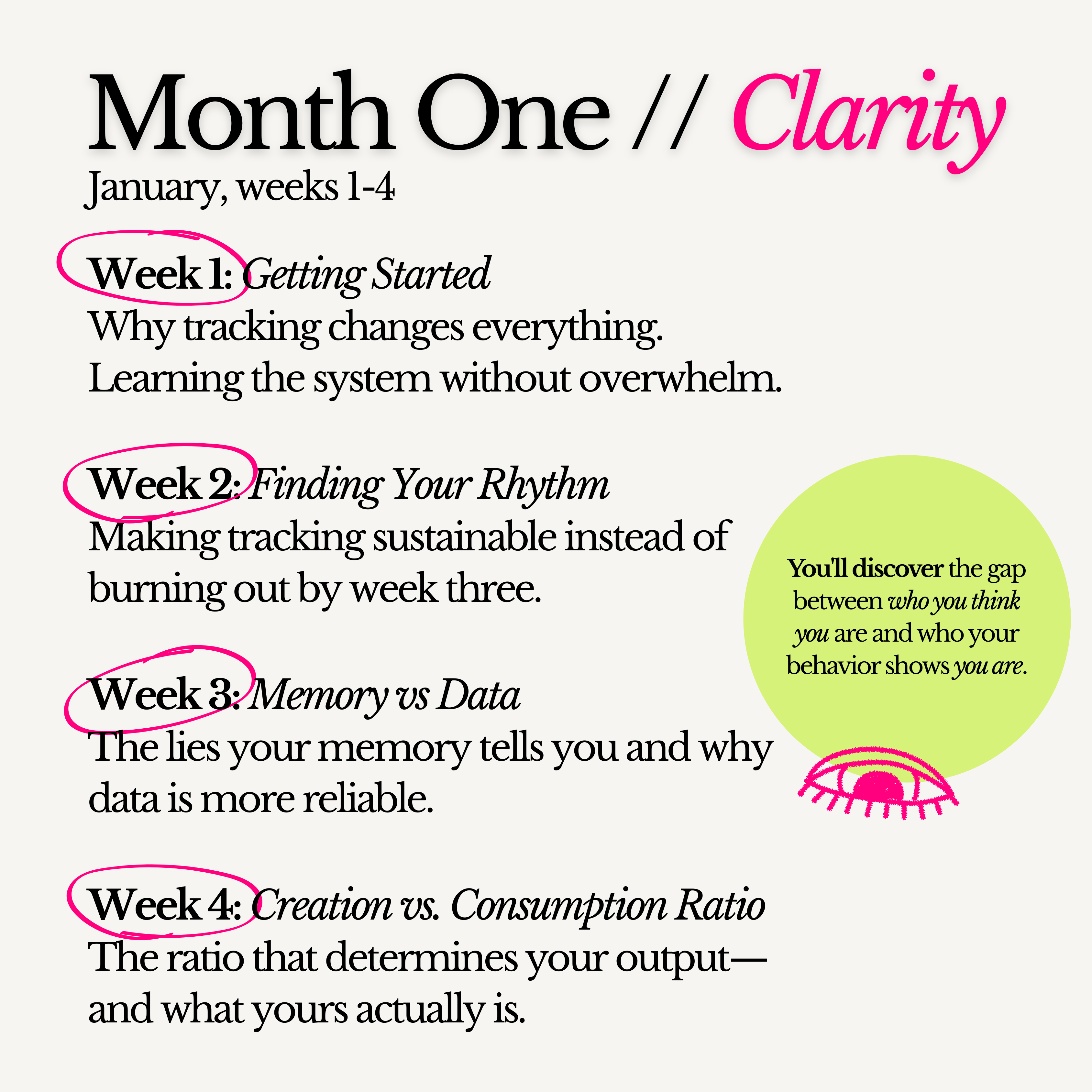
Conscious Creation is a twelve-week guided tracking program that runs January through March. Every week, you get an essay that teaches you how to read your data differently—not just “track your habits,” but how to see correlations, identify systems, recognize patterns you couldn’t see while living them. You get prompts that help you use the data strategically instead of just accumulating it. You get frameworks for making course corrections based on what the data reveals instead of what you hope is true.
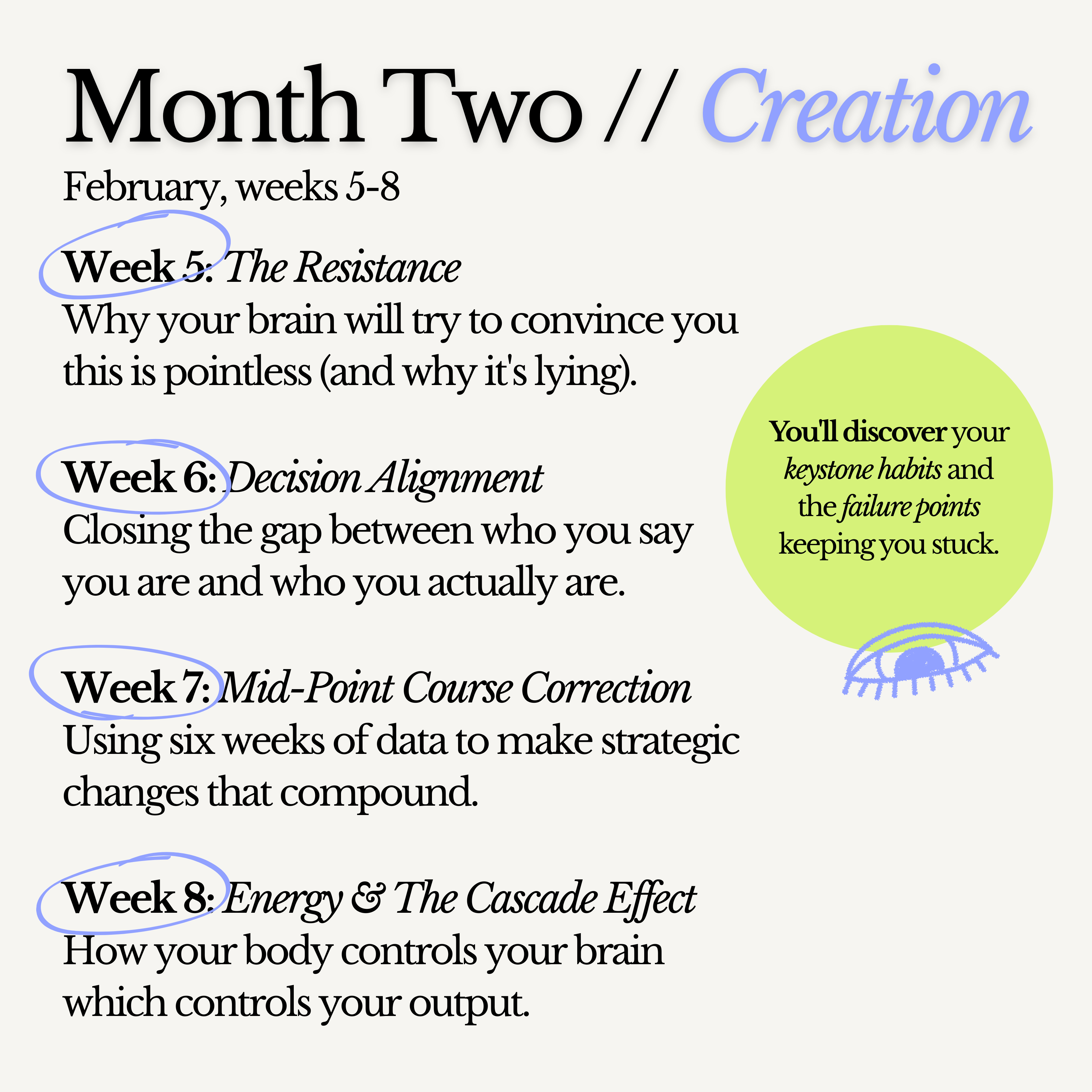
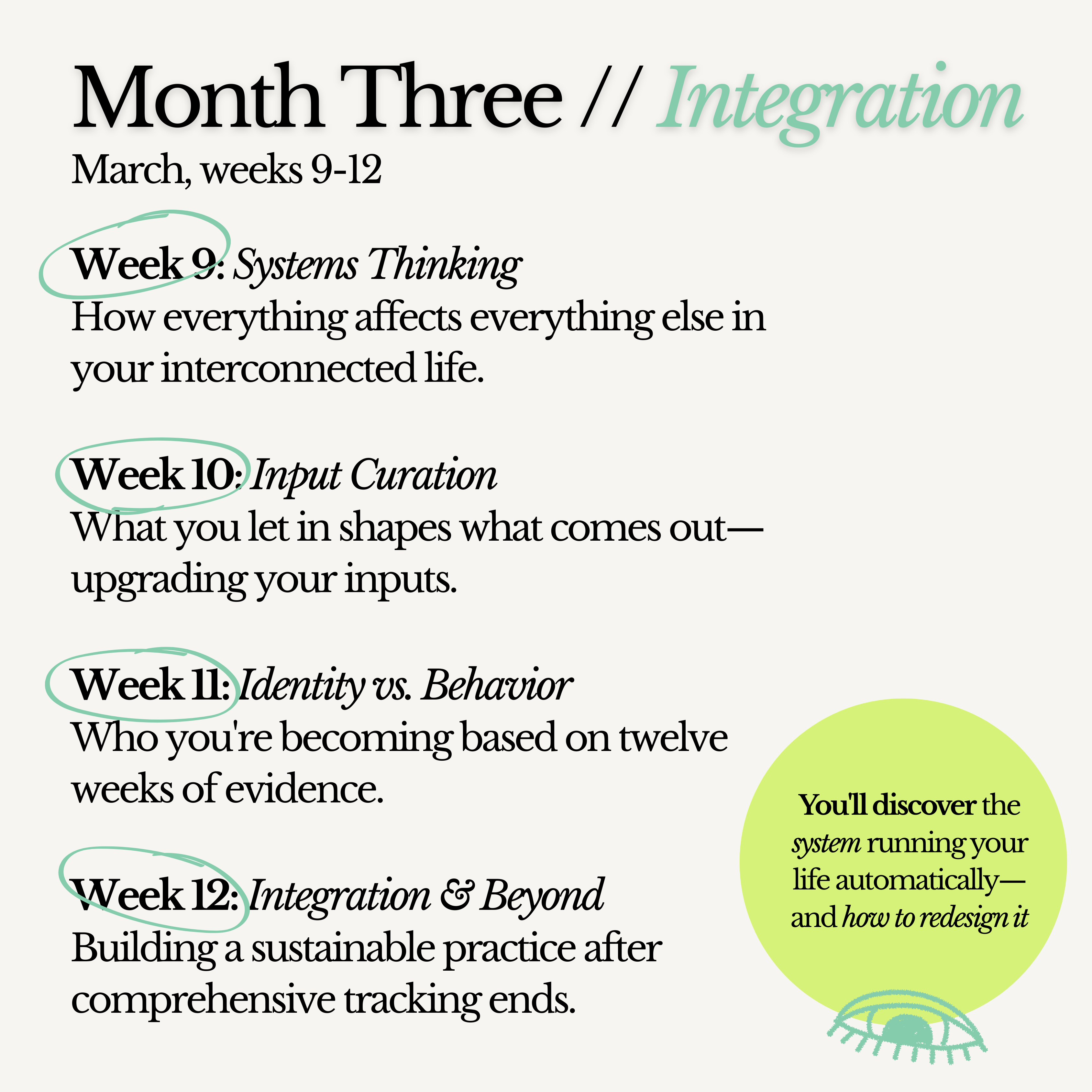
You’re tracking the same domains every day: physical state, creative output, decisions, energy, input quality, relationships, all of it (whatever you’ve chosen to track). The tracker doesn’t change week to week, but the lens through which you understand the data evolves. Week one is about learning to track without judgment. Week three is about seeing how memory lies to you. Week six is about decision alignment. Week eight is about the cascade effect from physical state to everything else. Week twelve is about integration—how to maintain what you’ve learned after comprehensive tracking ends, and how to continue using it and adapting it to your life moving forward.
By the end of twelve weeks, you’ll have a complete map of your behavioral patterns, your correlations, your feedback loops, your gaps between stated values and actual behavior. You’ll use AI to generate a dashboard like the one I’m sharing, turning your daily tracking data into visual proof of what changed from week one to week twelve. Not what you hoped changed, not what you tried to change, but what actually changed based on accumulated evidence.
90-day overview —
This is not for everyone.
This isn’t for people who want to be inspired without doing the work, or want their transformation to happen through intention alone, or people who would rather stay comfortable than see themselves clearly. Tracking is uncomfortable because it removes your ability to lie to yourself about how you’re spending your time, where your energy goes, and whether your behavior matches your stated priorities.
Most people will quit by week three when the novelty wears off and tracking feels boring. Some will quit by week five when the resistance shows up and their brain manufactures convincing reasons why tracking isn’t necessary anymore. The ones who make it to week twelve are the ones who decided that seeing themselves clearly matters more than staying comfortable, and that twelve weeks of daily tracking is worth having a level of self-knowledge most people never get.
If you’re still reading, you’re probably the type who finishes things.
You’re probably tired of operating on vibes and assumptions. You’re probably ready to see the gap between who you think you are and who you actually are, even though seeing it will be uncomfortable. You’re probably willing to do something boring and unsexy because you understand that real change happens through systems and evidence, not through inspiration and hoping things will just be different this time.
Conscious Creation starts January 5th. Twelve weeks, daily tracking, weekly essays and prompts, frameworks for reading your data and making strategic changes. By the end of March, you’ll have your own dashboard, your own evidence, your own map of the patterns that have been running your life automatically. What you do with that information is up to you, but at least you’ll know what’s actually true instead of what you’ve been telling yourself is true.
You have the power to change your life. You just have to decide that you will, and then prove it through twelve weeks of behavior that builds someone different than who you are right now.
Questions? Leave a comment or shoot me a message. I read everything.

January 5th. Hope to see you there. x


“Radical self responsibility!” Great framing
Hej, Stephanie is it possible to join now?