



Conscious Creation is a guided behavior tracking program. Every week, you get an essay that teaches you how to read your data differently, how to see correlations, identify systems, and recognize patterns you couldn’t see while living them. Plus prompts that help you use the data strategically, and frameworks for making course corrections based on what your data reveals about you.
The story behind the program, and how it works:

If you’re just joining us —
The program is self-paced. The weeks build on each other, but you can start anytime and move through at your own speed. Start with Week 1 where you’ll build your tracker and figure out what to track.

You’ve probably heard some version of the advice that says you should only change one thing at a time. Don’t overhaul your whole life, pick one habit, start small, focus.
It’s good advice, and I give it myself too, but there’s a second part to that advice that almost nobody talks about, and it’s the part that actually matters. When you change one thing and hold it long enough, other things start to change on their own. Because your life isn’t a collection of separate projects, it’s one system, and when you move one piece, the rest of the system has to adjust.
I’ll give you an example from one of our Conscious Creation participants. He decided his one system change was going to be leaving for work ten minutes earlier on office days. That’s it... ten minutes. He wasn’t trying to redesign his entire morning, or fix his stress, or improve his fitness routine, or become a different person. He simply moved his morning departure time.
Here’s what it changed, in his own words:
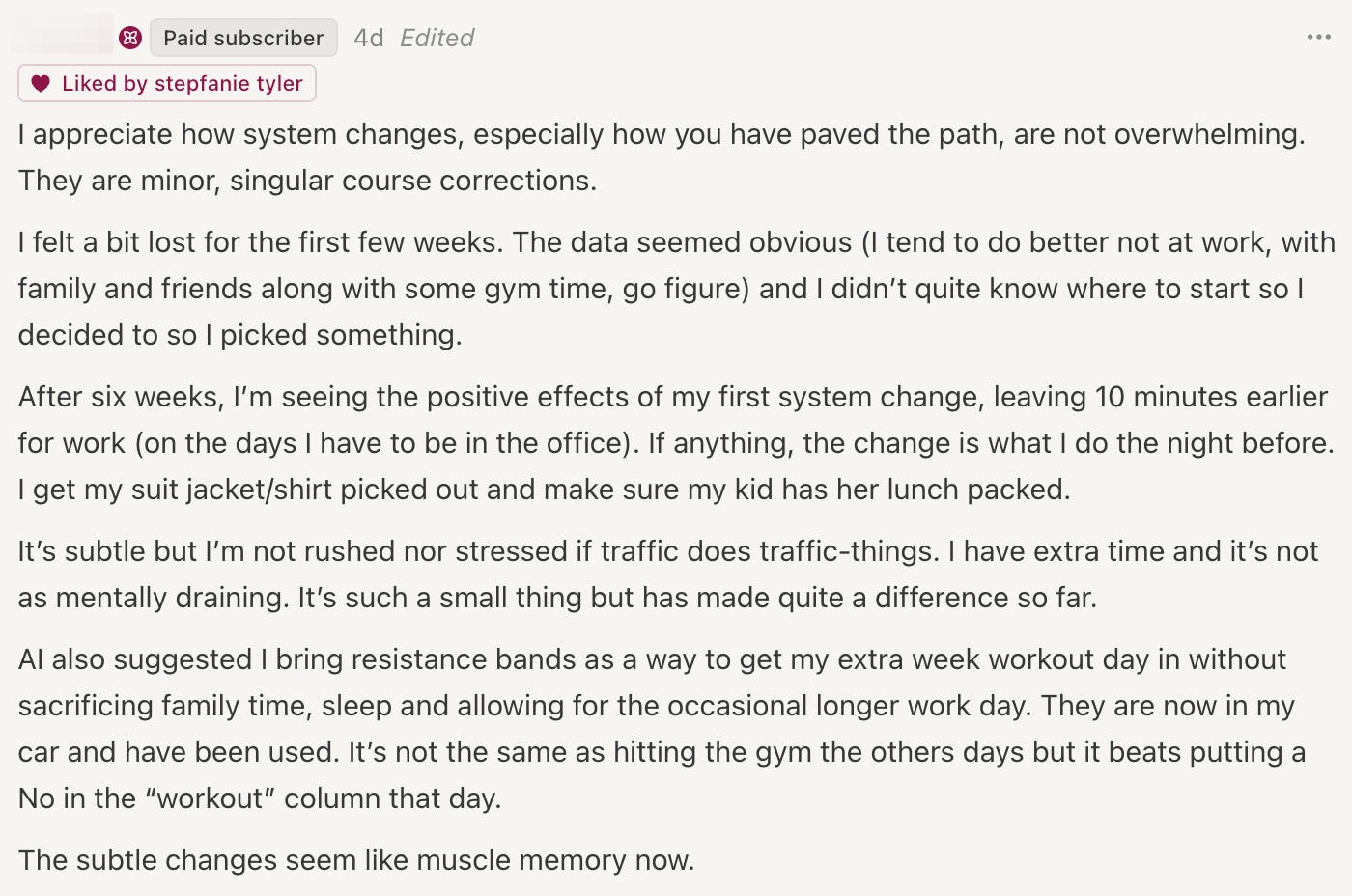
So, to leave ten minutes earlier, he started prepping the night before (picking out his clothes, packing his kid’s lunch) , which wasn’t part of his original plan. It just became necessary once the departure time moved. And because his mornings weren’t rushed anymore, he stopped arriving to work already stressed, he stopped spending the first hour of his day recovering from the chaos of getting out the door, his commute became calmer because he had a buffer for traffic, and ultimately, his mental energy at work improved because he wasn’t starting the day depleted.
But then something else happened that he definitely didn’t plan. Since he’s using AI to help him read his tracked data, it suggested that he start keeping resistance bands in his car. He’d been wanting to add an extra workout day but couldn’t figure out how to do it without cutting into family time, sleep, or the occasional long work day. Once the rest of his routine settled into this slightly calmer groove, a solution appeared, and now he’s getting a workout in on days when the gym isn’t realistic, because the resistance bands are just there in his car, ready when he needs them.
One decision, just ten minutes, and it touched his evenings, his mornings, his stress, his commute, his energy at work, and his fitness. He pulled one thread and the whole fabric shifted.
And that’s exactly what this week of Conscious Creation is all about. Finding your highest-leverage thread, and pulling.

What happened with that ten-minute change wasn’t random, and it isn’t just a nice anecdote about morning routines. It’s an example of something called systems thinking, and it’s one of the most useful mental models that most people have never been formally introduced to. (And if you’ve been reading with me for a while, you likely know by now, it’s my personal favorite and I yap about it constantly—and I’ve been dying to get to this week so I can finally work it into Conscious Creation!)

Systems thinking is a discipline that’s been around since the mid-20th century, and it shows up everywhere from engineering to urban planning to organizational management to ecology. The core idea is deceptively simple: most outcomes aren’t produced by a single cause, they’re produced by a web of interacting factors that influence each other, and you can’t understand the outcome—or change it—by looking at any one factor in isolation.
The classic example is traffic. A traffic jam isn’t caused by one bad driver, it’s the product of road design, traffic volume, speed differentials at merge points, signal timing, and the way humans react to brake lights three cars ahead. You could scream at every individual driver to “just drive better” and it wouldn’t change anything, because the problem isn’t any single driver’s behavior. It’s how the system is structured. The fix isn’t behavioral, it’s structural: widen the merge lane, adjust the signal timing, add a roundabout. Change the structure and the traffic resolves itself without anyone needing to become a better driver.
Businesses work the same way. A company with declining sales can fire every salesperson and hire new ones, but if the real issue is that the product is overpriced relative to what competitors are offering, or that the marketing is attracting the wrong audience, or that customer support is so bad that word of mouth is killing them, then the new salespeople will fail just like the old ones did. The CEO who only looks at the sales team is treating a symptom. The CEO who maps how product, pricing, marketing, support, and reputation all interact with each other and finds the actual bottleneck, is taking advantage of systems thinking.
The reason this matters for how you think about your own life is that most people approach personal change the way a bad CEO approaches declining sales. They identify the thing they don’t like (I’m not going to the gym enough, I’m not creating enough, I can’t focus, I eat like garbage in the evenings, whatever) and they attack it directly. More discipline, more willpower, more guilt when it doesn’t work. And when it doesn’t work, they assume the problem is them. They assume they’re not trying hard enough or they’re not disciplined enough, or worse, something is wrong with their character.
But the problem is rarely the individual behavior. The gym isn’t happening because you’re sleeping poorly, which means you’re exhausted by afternoon, which means you don’t have the energy for a workout, which means you scroll instead, which means you feel bad about yourself, which means you stay up late ruminating, which means you sleep poorly again. In that scenario, “just go to the gym” is the equivalent of screaming at drivers in a traffic jam. The intervention is aimed at the wrong level. The leverage point is the sleep, or the evening routine, or the stress that’s causing the rumination. It’s something upstream that, if you fixed it, would make the gym attendance resolve on its own.
That’s systems thinking applied to your life. And now, six-plus weeks of tracking data means you actually have the information to do it, instead of just guessing at what’s connected to what.
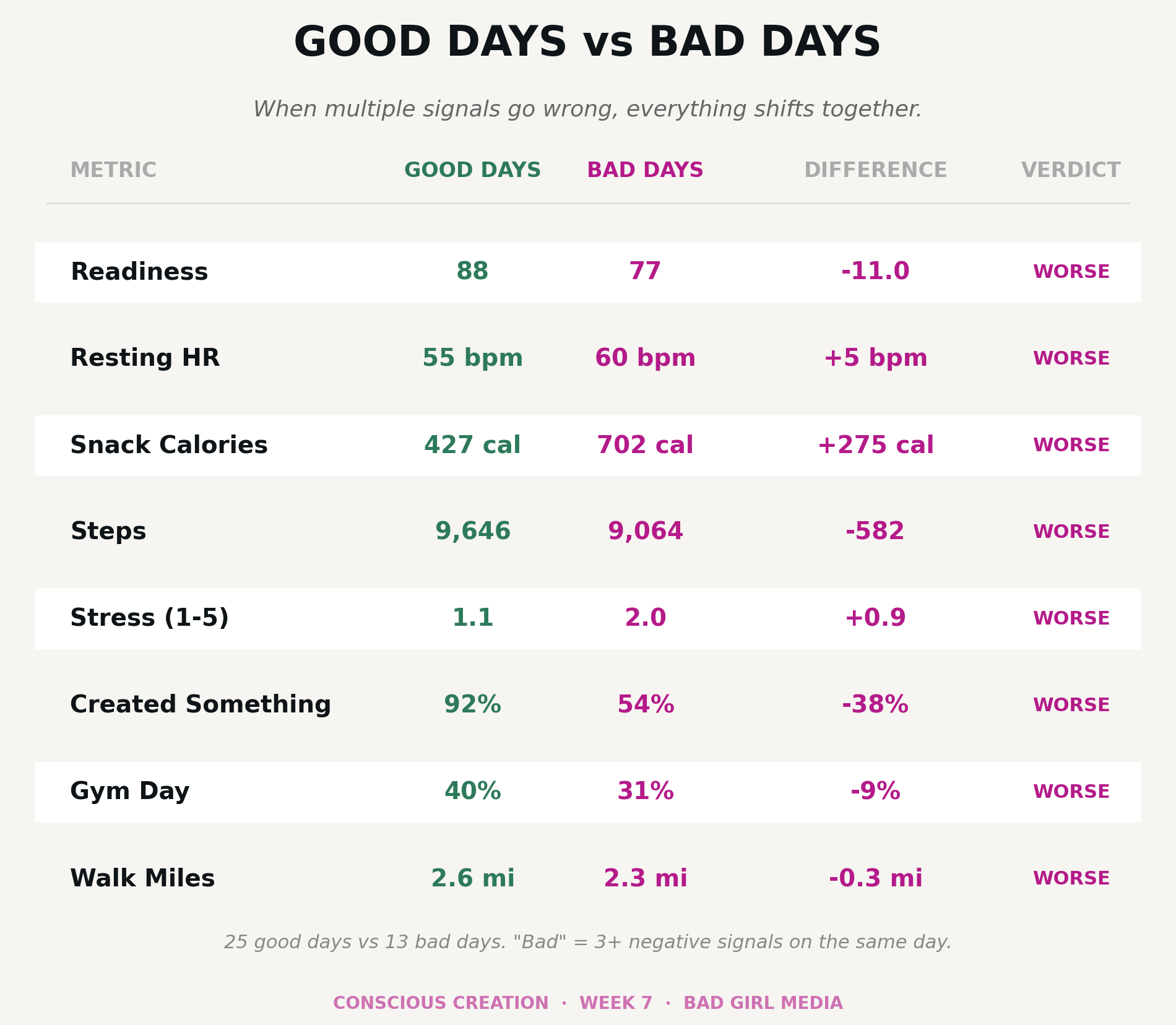
Here’s an example from my own data (I’ll explain in more detail below):
In this post:
Quick check-in
Why your system evaluation is only half the picture
What “seeing the system” actually means (and why it matters more than any single habit)
Keystone habits: the behaviors that move everything
Failure points: where one breakdown takes the whole day down
Feedback loops: the cycles that either compound your progress or keep you stuck
AI prompts for mapping your specific system
What to track this week + end of week reflection